Monday, September 3, 2018

Culture War, Schizofascism and Thinking Digitally

After a while at ground zero in the emerging culture war, I appreciated returning home to Vermont in 2010. But Arizona certainly did provide a preview of the weirdness to come — purportedly normal people buying into a warped “counter narrative” in which the President (Obama) was an illegal alien and an egomaniacal sheriff running inhuman “tent cities” was a folk hero and potential governor. In other words, there were early warnings that basic values — even assumed facts — were changing.

Around that time I began posting more actively on social media. Since some platforms keep everything we offer, a benefit is that it is possible to go back and reflect, rethink and aggregate. The experience can be confusing; after all, we live in a fragmented, short attention span world. On the other hand, it can also help to focus the mind and distill ideas. 

Aiming for the latter, here is a sample of (mainly Facebook) posts, from pre-Trump to recent days. The topics range from the rise of fascism and social media’s impacts to judging presidential fitness for office, Brett Kavanaugh, Caesar, Mussolini, brute force in Helsinki, war games in Ukraine, and the nostalgia of Space Force, all reflections of our reality-challenged world. Except where indicated, these are verbatim.

Sept. 1, 2018: After US White Nationalists defended Putin’s war to dismember Ukraine, he repaid them by using the Confederate flag as the basis for one promoted as the emblem of territory Russia occupied in southeastern Ukraine. Full text below.   

Aug 3, 2010: Arrived in Vermont after several weeks on the road, from AZ via Utah, Wyoming, Colorado, South Dakota, then across to St. Paul and down to Kentucky and Virginia before taking the Blue Ridge Parkway back to my "ancestral" home. Much to say...but not right now. Since returning I'm re-entering Burlington's social & political scene. Much to learn, and a far cry from Sheriff Joe and Arizona's sad psychic meltdown.

A year earlier, however, on Aug. 8, I’d observed... Thinking about fascism, a system and philosophy that uses racism, nationalism and suppression of opposition to achieve its ends. We may well be seeing its re-emergence in the extreme tactics of the corporate-manipulated movement to delegitimize the current US government. Can violence be far behind? It still CAN happen here...

Feb. 5, 2010: The post-modern world is turning out to be just a little chaotic. Truth has become a debatable notion, news is mainly spectacle, and self-promotion is the ultimate form of work. What's next? President Palin? Just sayin'.

April 19, 2011: A year after signing AZ's Papers Please law, Gov Jan Brewer has vetoed the state's Birther Bill. Does this mean that some on the Right see a "downside" to exploiting racism, delusion and irrational thinking for short-term gain? Maybe, but too late. The Trump's out of the bag and we're having another culture war.

It took several more years, but Trump happened and America’s culture war escalated...bigly.

Feb. 28, 2016: Trump retweets Mussolini saying "it is better to live one day as a lion than 100 years as a sheep." Asked why he smiles, "it's interesting." So, we've been warned. A bunga-bunga strongman. Sinclair Lewis nailed it.

Feb. 19, 2017: Able to serve? Even if a president has a mental disorder, that may say little about his fitness to serve. After all, Lincoln had severe depression, Theodore Roosevelt was probably bipolar, and Grant was an alcoholic. According to a study based on biographical data, 18 of America’s first 37 presidents met criteria suggesting they suffered from a psychiatric disorder during their lifetime: 24 % from depression, 8 % from anxiety, 8 % from bipolar disorder and 8 % from alcohol abuse or dependence. And 10 of those presidents showed signs of mental illness while they were in office.... You can be psychiatrically ill and perfectly competent, just as you can be mentally healthy but totally unfit... So the nation doesn’t need a shrink to help it to decide whether President Trump is fit to serve, mentally or otherwise.

Looking Back, Feb. 19, 2018: A year later we’re still grappling with the same question. The problem is that Trump supporters so identify with their leader that they view questions about his fitness or mental state as judgements about them. Thus, they project his problems onto others. It’s much easier and more comforting than admitting a mistake.

Jan. 31, 2018: Like a reality TV show, Michael Wolff’s book is basically a showcase for the crass motives and strange doings of its quirky subjects. It’s a pleasantly voyeuristic ride, as long as you don’t expect to much. Starting with convincing evidence that neither Donald Trump nor his minions actually wanted to win, Fire and Fury tracks the power dynamics pulling at this accidental president, mainly from the perspective of a Rasputin-like Steve Bannon. The other main factions are “establishment” Republicans like Reince Preibus — doomed to humiliation in this White House — and Trump’s family and friends...

March 7, 2018: “If you tell a lie big enough and keep repeating it, people will eventually come to believe it.” This advice from one infamous psychopath has clearly been taken to heart by another.

March 7, 2018: Despite hybrid warfare, perception management and the painful struggle over what is or isn’t fake, most of us still share a fact-based view of reality. On the other hand, polarization is increasing around the world, right along with faster communication.

March 19, 2018: Six falsehoods in one tweet: this could be some kind of record! Also sounds like the basis for a new reality show - THE BIGGEST LIAR. People compete to see if anyone can make up more (or bigger) lies than the president. Losers are humiliated on live TV. Spoiler: Trump always wins. 

March 19, 2018: Why are many Republicans abetting Trump’s fascist moves? Like Russians who see the USSR’s collapse as the nation’s great tragedy, GOP leaders recall what happened to Nixon (and afterward) and think, “Never Again!”

March 19, 2018: So, how exactly did the Trumpsters mess with American minds to seize power? The answer is emerging, but it’s not great news for 50 million users of this platform: their Facebook profiles were harvested by a UK-based academic and his company Global Science Research. Then a deal was struck to share this information with Cambridge Analytica, funded by billionaire Robert Mercer and manged by Steve Bannon on behalf of Trump. According to a whistleblower, most of this personal information was taken without authorization. Cambridge Analytica used it to build a powerful software program to predict and influence choices at the ballot box. Unfortunately, attempts have been made to keep this breach from being revealed.

March 22, 2018: Millions on Trump’s email list (not Twitter) just received a signed, high-pitched appeal: “I will not hide from the truth -- this is a WITCH HUNT,” he brays. Then accuses Nancy Pelosi of using Russia “as a political ploy to RAISE MONEY from her supporters.” How dare she, right? Ploys are his thing. But Pelosi is such a time-tested trigger word.

Then the conspiracy theory: that “the swamp” (it’s whatever you imagine) is using government as a weapon to overturn elections. Namely, his. Bad swamp! This is followed by an appeal for just one dollar. So it’s not about the money. What then? Apparently linking the “witch hunt” with his agenda — build the wall, stop immigration and no more “nation-building.” Plus an attempt to appropriate the progressive call for a “fair economy.”

March 24, 2018: Straight talk from a Nation columnist about Russia and the election. Katha Pollitt addresses some key questions and concludes, “If you’re a skeptic, ask yourself what could change your mind. If the answer is nothing, you may be in for an embarrassing time.”

April 15, 2018: Beyond social media, perceptions have been manipulated by experiments called "reality shows," most based on the assumption that competition, fame and distrust are fundamental truths. And the contestants aren’t the only subjects. So are the viewers.

May 24, 2018: Like a long anticipated prequel, Trump/Russia: A Definitive History, provides the backstory — a sordid tale of organized crime, shape-shifting oligarchs and money laundering —that led to our current predicament. One of Trump’s biggest lies, it turns out, is his protest about having nothing to do with Russia. Its the opposite. Russia has been his piggy bank and object of desire for decades. And his election was a perfect storm, fueled by the combined force of his narcissism and greed and Putin’s thirst for respect and revenge.

May 29, 2018: Just when we thought we were moving forward, we’ve been pulled back into raw class struggle (among other challenges). Today’s big players are assorted oligarchs, a veritable international league of tyrants and crooks that ignore all the laws and norms they can get away with. And they’re playing for keeps.

July 8, 2018: Two years ago, while reading this rich and revealing history of Italy under fascist rule, it was already hard not to be reminded of Donald Trump. As R.J.B. Bosworth shows in Mussolini’s Italy, Mussolini's brand of fascism was also powered more by charisma than policies, and drew from a widespread sense of victimhood that fueled aggression, authoritarian quick fixes, and a desperate yearning to recapture a glorious, yet mythical past. It’s all too familiar. World War II ended the Duce's tyranny, but clearly did not excise fascism's totalitarian approach and mindset. Unfortunately, traces and echoes can be found today in many democracies and a league of crypto-fascist states may well be in formation.

July 10, 2018: Here’s Francis Boyle, law professor and Federalist Society critic, on Trump’s Supreme Court nominee. “Kavanaugh drafted portions of the Starr report, a political hit job. Perhaps more importantly, he drafted parts of the Ken Starr 'referral' to the U.S. Congress recommending that Bill Clinton be impeached for a blowjob and lying about a blowjob. Kavanaugh worked for then-Republican nominee George W. Bush in Bush v. Gore, which effectively robbed the American people of the presidency. 

 "The fact that if Kavanaugh gets through, the entire Supreme Court will have gone to Harvard or Yale is terrible for the country. And I say that as having graduated magna cum laude from Harvard Law.”

July 17, 2018: Moments before the (Helsinki) Putin-Trump presser Sam Husseini, who was covering it for The Nation, was sitting on the US side when he held up a sign reading "Nuclear Weapons Ban Treaty." That was enough to draw security men, who questioned him briefly before opting for removal. As Sam struggled with guards, at one point waving the sign but mainly trying to keep it out of one man's hands, other journalists pulled out phones and started recording the incident. No press outrage, however, and no word yet on how he was treated afterward.

July 22, 2018: This just In: Trump just admitted he misspoke when declaring himself a “stable genius.” Meant to say “evil genius,” arguing that things are going “precisely as unplanned.” Asking to comment, Rudy Guliani noted, “That proves he’s at least half right.” #RudyAndTheBeast

Aug. 4, 2018: It turns out Trump has built a wall...of tweets, a barrier of lies “so big and strong it is impenetrable to criticism, logic or reason.” And we’re all going to pay for it. Quote from the Daily Show’s Presidential Twitter Library.


Aug. 9, 2018: During Nixon’s time it sometimes felt like Rome. It’s feeling that way again. In 44 BC, Julius Caesar became dictator of the world's most powerful empire. But his "vulgar scheming for the tawdriest mockeries of personal worship", as H.G. Wells put it, became a shameful record. The air buzzed with talk of democracy and the proletariat. But the popular "comitia," the gathering of tribes for public votes, didn’t reflect the feelings of the masses. The sham forced the cheated and suppressed to use strikes and insurrection. And it didn’t end well, for Caesar, Rome or Nixon. 

Aug. 10, 2018: Here we go again! Space Force, the president’s latest weapon of mass distraction, is nothing new. About 20 years ago, there were already big plans. As the Space Command said in a slick Vision for 2020 brochure, "Control of space is the ability to assure access to space, freedom of operations within the space medium, and an ability to deny others the use of space if required." As usual they were shooting for “dominance.” In other words, the past is calling and they want their empty rhetoric back. This story made it to the censored top ten, which is probably why the idea can be recycled to “low information” people (aka uninformed and deluded).

Aug. 15, 2018: TrumpWorld sometimes looks like a modern kitsch version of Dante’s hell, a land of perverted desire — desire even for Hell itself. Filled with people who know their greed and excess will destroy them, yet choose to binge anyway. It’s a state of mind that spurs leaders to pursue war and destruction for its own sake. Rather than feeling fear, Trump and his disciples seem driven by insatiable appetites.


Aug. 28, 2018: Now it’s been a full decade since McCain faced Obama, Palin got her close up, and reality began to blur. Soon the economy collapsed and conspiracy theorists went mainstream.

Sept. 1, 2018: In our “schizofascist” world, Russia is supposedly antifascist. But really the opposite. One clue is that many of its allies, like US White Nationalists Richard Spencer and David Duke, are openly fascist. They defended Putin’s war to dismember and absorb Ukraine. And he repaid them for the support by using the Confederate battle flag as the basis for a new one promoted as the emblem of Novorossiia, the territory Russia occupied in southeastern Ukraine. That made them allies with fascist parties and factions in Hungary, Poland, Bulgaria, Italy and elsewhere that took Russia’s side. The war became a training field for 21st century terrorism. The Serbian who attempted a coup in Montenegro in 2016 has admitted that he was recruited by Russian nationalists and trained in Ukraine.

September 2, 2018: Simultaneously engaging and deeply disturbing, (The Road to Unfreedom) should feature a warning: Abandon your illusions, since they aren’t likely to survive. Building on ideas introduced in his pocket guide, On Tyranny, Timothy Synder describes the last six years as a period of shattering change that has led Russia, America and parts of Europe into what he calls “schizofascism,” or, in Trump’s case, possibly “sado-populism.” A core concept is the shift — with strategic nudges by the Putin gang — from the politics of inevitability to the politics of eternity. Inevitability politicians argue that specifics of the past are ultimately irrelevant, merely grist for progress; Eternity politicians see endless cycles of threat, victimhood, and restoration, and have a penchant for supressing facts, dismissing reality, and creating political fiction.

“Americans were vulnerable to the politics of eternity,” Snyder explains, “because their own experiences had already weakened inevitability. Trump’s proposal to ‘make America great again’ resonated with people who believed, along with him, that the American dream was dead. Russia had reached the politics of eternity first, and so Russians knew the techniques that would push Americans in the same direction.”

Wednesday, August 29, 2018

GUILT BY ASSOCIATION: THE BERSTER CASE

If you still say fascism can’t happen here, consider this: in some ways, it’s been incubating for years. Four decades ago fears of foreign terrorism were exploited with lies to undermine basic rights. In Vermont, the danger became clear after a young German woman fleeing repression was arrested crossing the border. 


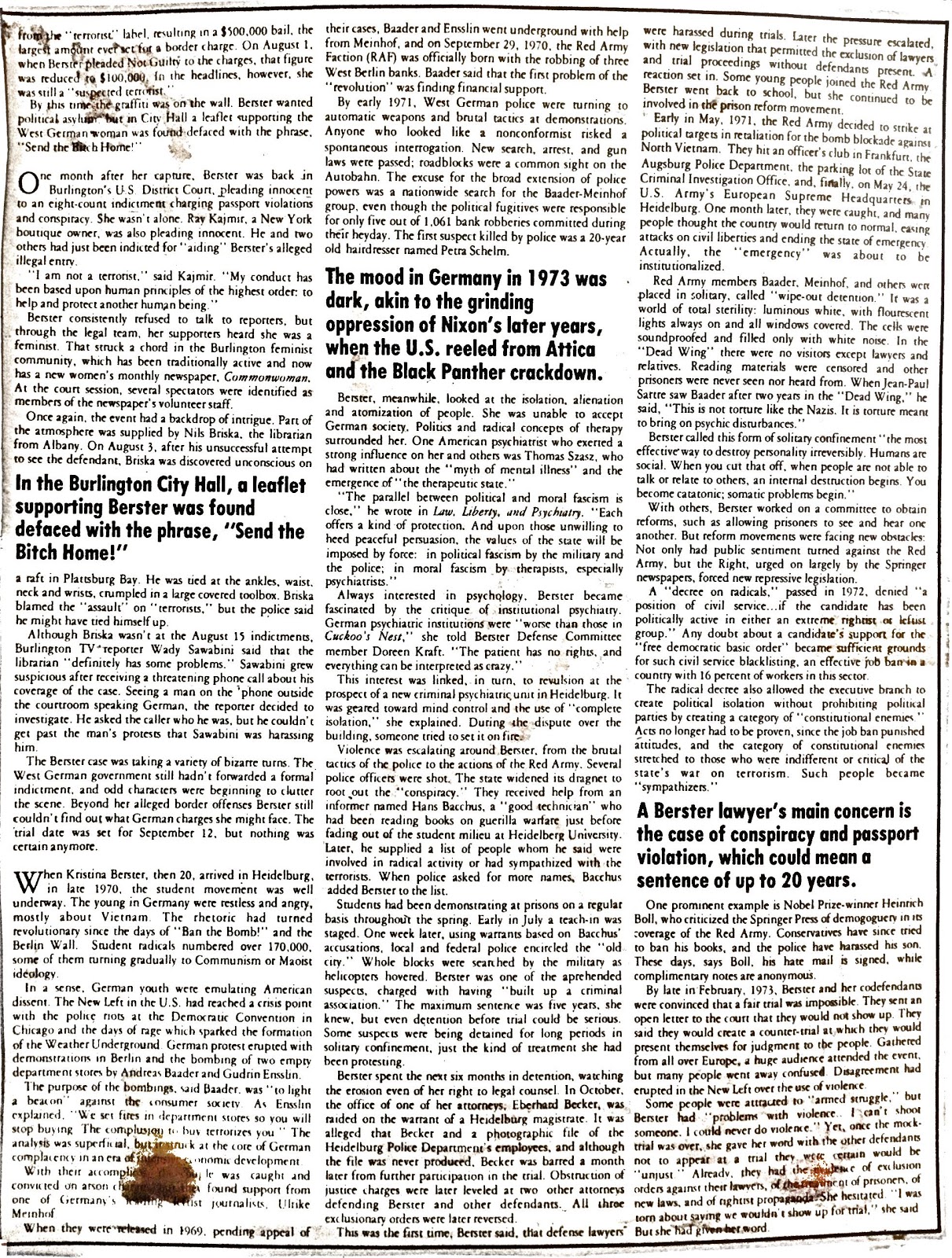
Originally published September 5, 1978, in The Vermont Vanguard Press, before a landmark federal trial in Burlington.

How disinformation turned Kristina Berster 
into an “enemy of the state” 

By Greg Guma

AFTER ONE week in the United States, Kristina Berster wasn't sure who wanted her most, the U.S. or West Germany. In fact, she wasn't sure if anyone wanted her at all. But the FBI knew exactly what it wanted: a terrorist in the headlines. And they used the West German woman to promote their theory of international conspiracy. Behind the headlines, however, evidence surfaced to suggest that if a conspiracy actually existed, it involved the intelligence agencies of the so-called free world. 
      On July 24, 1978, Berster was being held in the Albany jail. Her bail  was set at $500,000, and the West German government could not decide whether to extradite her, ironic in view of the sensational media coverage here making much ado about the woman's supposedly criminal past. The West Germans had a five-year-old warrant, but wondered if another lengthy political trial involving a "fringe figure" in an alleged criminal conspiracy was worth all the trouble. 


      The FBI was much more excited about the 28-year-old woman who had been found walking near the border between Canada and Vermont the previous Sunday night, July 16. According to the FBI press office, she was a member of a defunct terrorist group. 
      This description marked a shift to a softer tone from the Bureau's first announcement. For days, Berster had been called “terrorist,” “alleged terrorist,'' and a member of the Baader-Meinhof “gang.” (In Germany, anyone who called Baader-Meinhof a "group" was labeled a sympathizer.) Her arrest, according to an FBI press officer, "marked the first time a member of the notorious urban gang has been caught trying to enter this country.” In Burlington, Assistant U.S. Attorney Jerome O'NeilI called Berster one of the 34 most wanted persons in the world.
      When the West German Embassy corrected the FBI’s error, a “verbal statement saying she was not a member of that group” was issued by the agency, according to its press officer, Tom Harrington. At that point, even a public apology would not have altered the impact of Berster’s earlier bad press, which seemed designed to suggest that the European shadow of violence hovered over the US.
      The German warrant, issued in March 1973, when Berster failed to appear for a trial on charges of criminal association, might not actually be covered in the US-West German extradition treaty. In any case, she was charged only with membership in a radical group which might have had ties to terrorists, not with membership in a terrorist group. To some, this sounded serious, but not to anyone who knows just how broad such charges can get in West Germany.
      Even the border and passport violations were blurred in the international shuffle. The US Border Patrol took credit for the arrest, and Berster was held in the Chittenden Correctional Center. Yet she was caught between checkpoints and interrogated for several hours by the Royal Canadian Mounted Police (RCMP). The Mounties apparently were gifted with ESP; they asked unusually knowledgeable questions about things they could not have known, and her identity was established through a computerized intelligence system in Montreal. Her luggage, seized when her alleged accomplices were stopped at a nearby customs station, was never returned.
      Berster was confused and suspicious. Would she be extradited? Had she been under surveillance, perhaps ever since she entered Canada via Mirabel airport on July 8? Her lawyer, New Yorker Nicholas Altomerianos, was too busy denying her connection to Baader-Meinhof to unravel the intelligence mysteries.
      And the next few days only heightened her anxiety. On Tuesday, July 25, Albany librarian Nils Briska tried to sneak past guards to see the prisoner with an ominous-looking briefcase. When caught, he cursed the sheriff’s deputies, taken off guard by the early visitor masquerading as an attorney. There was no bomb in the briefcase, or clear reason for Briska’s attempt.
      On Wednesday two visitors did get through security, but they had some portentous credentials: German intelligence. Their offer was simple. Charges in Germany could be reduced or even dropped if she gave them information — especially names. When she declined, the conversation took a threatening turn. 
      “Then you’ll be coming with us,” one said.


ASIDE FROM assorted agents and border officials, the first people to hear about Kristina Berster were reporters. And among that special breed, Mike Donoghue had the edge. A veteran staffer for the Burlington Free Press, Donoghue had just about the best police contacts in Vermont. Sometimes this led to hassles, such as when Donoghue used to get tipped off to busts by ex-supernarc Paul Lawrence. They were drinking buddies, but the informer-cop turned out to be lying about his buys from local dealers.
      Donoghue got a “wake up call” about Berster early on July 20 and read some AP copy which called Berster a member of Baader-Meinhof. When questioned, he wouldn’t say whether the FBI had also spread that rumor. But Rutland Herald Managing Editor Steve Terry said that FBI Press Officer Harrington gave the faulty facts to his reporter. Harrington denied it, saying “we didn’t put her with any group.” Nonetheless, the Herald headline screamed, TERRORIST HELD AFTER ATTEMPT TO ENTER U.S., on the morning of July 21, and FBI Director Willam Webster described various charges.
     WCAX reporter Wady Sawabini was also tackling the story, tipped by an unnamed source in the Burlington Federal Building. Sawabini was also known for his “contacts” and for his film coverage of antiwar demonstrations in the early ‘70s. He lept quickly into the Berster case, giving information to lawyers and tracking the principals in the affair — on film whenever possible.
      Despite the flurry of inaccurate stories (when the FBI does an intentional character assassination it is called “disinformation”), US and German officials made only cautious comments. Assistant US Attorney Jerome O’Neill said he didn’t think she was a member of Baader-Meinhof; the word from the State Department was that German extradition was unlikely.
      While investigations proceeded on two continents, a defense team was being formed. In Burlington, the defendant would have the counsel of William Kittel, as well as Albany attorney Dennis Schlenker. But the local team would be led, whether they liked it or not, by William “Wild Bill” Kunstler. This was just the case he had been waiting for: a defendant seeking political asylum from a country that had begun to indict and convict so-called radical lawyers. It was a “marriage” made in Heidelburg and Chicago.
     “This case goes far beyond Kristina Berster,” said Kunstler, after approaching the defendant to offer his services. “I am very concerned with West Germany’s treatment of so-called terrorists and the so-called left wing lawyers who defend them.”
      Kunstler also mentioned the “panic” reaction growing from the “terrorist” label, resulting in a $500,000 bail, the largest amount ever set for a border charge. On August 1, when Berster pleaded not guilty to the charges, that figure was reduced to $100,000. In the headlines, however, she was still a “suspected terrorist.”
      By this time the graffiti was on the wall. Berster wanted political asylum, but in City Hall a leaflet supporting the West German woman was found defaced with the phrase, “Send the bitch home!”


ONE MONTH after her capture, Berster was back in Burlington’s U.S. District Court, pleading innocent to an eight-count indictment charging passport violations and conspiracy. She wasn’t alone. Ray Kajmir, a New York boutique owner, was also pleading innocent. He and two others had just been indicted for “aiding” Berster’s alleged illegal entry.
      “I am not a terrorist,” said Kajmir. “My conduct has been based upon human principals of the highest order: to help and protect another human being.”
      Berster consistently refused to talk to reporters, but through the legal team her supporters heard she was a feminist. That struck a chord in the Burlington feminist community, which had been traditionally active and had a new women’s monthly newspaper, Commonwoman. At the court session, several spectators were identified as members of the newspaper’s volunteer staff.
      Once again, the event had a backdrop of intrigue. Part of the atmosphere was supplied by Nils Briska, the librarian from Albany. On August 3, after his unsuccessful attempt to see the defendant, Briska was discovered unconscious on a raft in Plattsburg Bay. He was tied at the ankles, waist, neck and wrists, crumpled in a large covered toolbox. Briska blamed the assault on “terrorists,” but the police said he might have tied himself up.
      Although Briska wasn’t at the August 15 indictments, Burlington TV reporter Wady Sawabini said that the librarian “definitely has some problems.” Sawabini grew suspicious after receiving a threatening phone call about his coverage of the case. Seeing a man on the phone outside the courtroom speaking German, the reporter decided to investigate. He asked the caller who he was, but he couldn’t get past the man’s protests that Sawabini was harassing him.
      The Berster case was taking a variety of bizarre turns. The West German government still hadn’t forwarded a formal indictment, and odd characters were beginning to clutter the scene. Beyond her alleged border offenses Berster still couldn’t find out what German charges she might face. The US trial date was set for September 12,  but nothing was certain anymore.


WHEN KRISTINA Berster, then 20, arrived in Heidelburg in late 1970, the student movement was well underway. The young in Germany were restless and angry, mostly about Vietnam. The rhetoric had turned revolutionary since the days of “Ban the Bomb!” and the Berlin Wall. Student radicals numbered over 170,000, some of them turning gradually to Communism or Maoist ideology.
      In a sense, German youth were emulating American dissent. The New Left in the US had reached a crisis point with the police riots at the Democratic Convention in Chicago and the Days of Rage, which sparked the formation of the Weather Underground. German protest erupted with demonstrations in Berlin and the bombing of two empty department stores by Andreas Baader and Gudrin Ensslin.
      The purpose of the bombings, said Baader, was “to light a beacon” against the consumer society. As Ensslin explained, “We set fires in department stores so you will stop buying. The compulsion to buy terrorizes you.” The analysis was superficial, but it struck at the core of German complacency in an era of intensive economic development.
      With their accomplices, the couple was caught and convicted on arson charges, but they found support from one of Germany’s leading leftist journalists, Ulrike Meinhof.
      When they were released in 1969, pending appeal of their cases. Baader and Ensslin went underground with help from Meinhof, and on September 29, 1970, the Red Army Faction (RAF) was officially born with the robbing of three West Berlin banks. Baader said the first problem of “the revolution” was finding financial support.
      By early 1971, West German police were turning to automatic weapons and brutal tactics at demonstrations. Anyone who looked like a nonconformist risked a spontaneous interrogation. New search, arrest and gun laws were passed; roadblocks were a common sight on the Autobahn. The excuse for the broad extension of police powers was a nationwide search for the Baader-Meinhof group, even though the political fugitives were responsible for only five out of 1,061 bank robberies committed during their heyday. The first suspect killed by police was a 20-year-old hairdresser named Petra Schelm.
       Berster, meanwhile, looked at the isolation, alienation and atomization of people. She was unable to accept German society. Politics and radical concepts of therapy surrounded her. One American psychiatrist who exerted a strong influence on her and others was Thomas Szasz, who had written about the “myth of mental illness” and the emergence of “the therapeutic state.”
      “The parallel between political and moral fascism is close,” he wrote in Law, Liberty, and Psychiatry. “Each offers a kind of protection. And upon those unwilling to heed peaceful persuasion, the values of the state will be imposed by force: in political fascism by the military and the police; in moral fascism by therapists, especially psychiatrists.”  
      Always interested in psychology, Berster became fascinated by the critique of institutional psychiatry. German psychiatric institutions were “worse than those in Cuckoo’s Nest,” she told Berster Defense Committee member Doreen Kraft. “The patient has no rights, and everything can be interpreted as crazy.” (In fact, I was interviewing her in her cell, having accompanied Doreen to the Albany jail where she was being held between court appearances and posed as a member of her defense committee. It turned out to be the only interview she gave before her trial.) 
      Berster’s interest was linked, in turn, to revulsion at the prospect of a new criminal psychiatric unity in Heidelburg. It was geared toward mind control and the use of “complete isolation,” she explained. During the dispute over the building, someone tried to set it on fire.
      Violence was escalating around Berster, from the brutal tactics of the police to the actions of the Red Army. Several police officers were shot. The state widened its dragnet to root out the “conspiracy.” They received help from an informer named Hans Bacchus, a “good technician” who had been reading books on guerrilla warfare just before fading out of the student milieu at Heidelburg University. Later, he supplied a list of people whom he said were involved in radical activity or had sympathized with the terrorists. When police asked for more names, Bacchus added Berster to the list.
      Berster spent the next six months in detention, watching the erosion even of her right to legal counsel. In October, the office of one of her attorneys, Eberhard Becker, was raided on the warrant of a Heidelburg magistrate. It was alleged that Becker had a photographic file of the Heidelburg Police Department’s employees, and although the file was never produced, Becker was barred a month later from further participation in the trial. Obstruction of justice charges were later leveled at two other attorneys defending Berster and other defendants. All three exclusionary ordered were later reversed.
      This was the first time, Berster said, that defense lawyers were harassed during trials. Later the pressure escalated, with new legislation that permitted the exclusion of lawyers and trial proceedings without defendants present. A reaction set in. Some young people joined the Red Army. Berster went back o school, but she continued to be involved in the prison reform movement.
      Early in May, 1971, the Red Army decided to strike at political targets in retaliation for the bomb blockade against North Vietnam. They hit an officer’s club in Frankfort, the Augsburg Police Department, the parking lot of the State Criminal Investigation Office, and finally, on May 24, the US Army’s European Supreme Headquarters in Heidelburg. One month later, they were caught, and many people thought the country would return to normal, easing attacks on civil liberties and ending the state of emergency. Actually, the “emergency” was about to be institutionalized.
      Red Army members Baader, Meinhof, and others were placed in solitary, called “wipe out detention.” It was a world of total sterility: luminous white, with fluorescent lights always on and all windows covered. The cells were soundproofed and filled only with white noise. In the “Dead Wing” there were no visitors except lawyers and relatives. Reading materials were censored and other prisoners were never seen nor heard. When Jean-Paul Sartre saw Baader after two years in the “Dead Wing,” he said, “This is not torture like the Nazis. It is torture meant to bring on psychic disturbances.”
      Berster called this form of solitary confinement “the most effective way to destroy personality irreversibly. Humans are social. When you cut that off, when people are not able to talk or relate to others, an internal destruction begins. You become catatonic; somatic problems begin.”
      With others, Berster worked on a committee (the Socialist Patients Collective) to obtain reforms, such as allowing prisoners to see and hear one another. But reform movements were facing new obstacles: Not only had public sentiment turned against the Red Army, but the Right, urged on largely by the Springer newspapers, forced new repressive legislation.
      A “decree on radicals,” passed in 1972, denied “a position of civil service...if the candidate has been politically active in either an extreme rightist or leftist group.” Any doubts about a candidate’s support for the “free democratic basic order” became sufficient grounds for such ciivil service blacklisting, an effective job ban in a country with 16 percent of workers in this sector.
      The radical decree also allowed the executive branch to create political isolation without prohibiting political parties by creating a category of “constitutional enemies.” Acts no longer had to be proven, since the job ban punished attitudes, and the category of constitutional enemies stretched to those who were indifferent or critical of the state’s war on terrorism. Such people became “sympathizers.”
      One prominent example was Nobel Prize winner Heinrich Boll, who criticized the Springer Press for demagoguery in its coverage of the Red Army. Conservatives tried to ban his books, and the police harassed his son. These days, said Boll, his hate mail is signed, while complimentary notes are anonymous.
      By late February 1973, Berster and her codefendants were convinced that a fair trial was impossible. They sent an open letter to the court that they would not show up. They said they would create a counter-trial at which they would present themselves for judgement to the people. Gathered from all over Europe, a huge audience attended the event, but many people went away confused. Disagreement had erupted in the New Left over the use of violence.
      Some people were attracted to “armed struggle,” but Berster had “problems with violence.... I can’t shoot someone. I could never do violence.” Yet, once the mock-trial was over, she gave her word with the other defendants not to appear at a trial they were certain would be “unjust.” Already, they had the evidence of exclusion orders against their lawyers, of the treatment of prisoners, of new laws, and of rightist propaganda. She hesitated. “I was torn about saying we wouldn’t show up for trial,” she said. But she had given her word.
      At first, Berster didn’t think she would have to become a fugitive. No one was arrested after the mock trial. Later, however, she saw “Wanted” posters and realized that she couldn’t stay in Germany and remain free. The mood in the country was dark, akin to the grinding oppression of Nixon’s later years, when the antiwar movement faltered and the US reeled from Attica and the Black Panther crackdown.
      The key witness at trial, Hans Bacchus, recanted twice, but already Berster was out of the city. She lived hand-to-mouth, cut off from support by family and friends. Looking back, she wondered how much time she would have served if she’d been convicted. Perhaps leaving was a mistake, but it was too late to look back. And, to judge from recent German trials, there was no clear path back to freedom.

WHILE BERSTER waited in Montreal for a chance to enter the US, a German lawyer was being convicted of “conspiracy to assist his clients to maintain their identities.” Kurt Groenwold, who had defended members of the Red Army in the early 1970s, was sentenced to two years imprisonment because his assistance provided support for  the suspects. Defending “enemies of the state” in anything but a perfunctory manner could be grounds for a conspiracy charge in West Germany.
      The Groenwold decision, on appeal to the Federal Appellate Court, could set the stage for 30 similar cases. The radical lawyer had based his defense on the right of his clients to determine  the nature of their defense, but the court rejected the argument on the grounds that such a defense would “promote the ideas of the defendants.”
      Germany’s crackdown on left-leaning attorneys came as no surprise to legal experts on both sides of the ocean. Most leftist attorneys in Germany had been disbarred and indicted on similar charges. But the repression of lawyers served as a major incentive for Kunstler to take on Berster’s case.
      The case of Kurt Groenwold followed a pattern in many ways similar to that of Berster’s former attorney, Becker. After the attempt to disbar lawyers in 1971, the Federal Parliament in 1975 passed amendments that were pointedly labeled “Lex Baader-Meinhof.” These laws provided the prosecution with legal grounds to bar overly-aggressive attorneys, to limit the number of lawyers on a case, and to exclude defendants from their own trials if the court judged that “they willfully caused their own unfitness.”
      On March 11, 1975, Groenwold was excluded from the Baader-Meinhof trial. Three months later, he was disbarred. During an interview with Stew Albert that year, Groenwold explained that he had “only been disbarred, perhaps because of my wealthy family associations... I have been lucky for now...” He said that criticism of the constitution or government had become a crime, and that lawyers could be jailed for objecting to prison conditions.
      “Always the so-called liberals and social democrats come to power and make the state bigger and more powerful,” he explained. It was a familiar scenario. “They think that if they do the work of the fascists, then the fascists will never come to power. But always, the fascists eventually come to power and then the social democrats are arrested by the very policemen they hired.” 
      Groenwold’s case could end up in the European Court of Human Rights, possibly dovetailing with intensified criticism of the job ban by the Betrand Russell Tribunal, which concluded in April that repressive laws were eroding constitutional rights, allowing censorship through extra-legal measures, and denying citizens the right to practice their professions because of their political views. Such chilling effects could be the price of the German preoccupation with order, fueled by fears that the era of Hitler might be repeated. Dissent was no longer tolerated. The prescription for the social crisis included pre-censorship, confiscation of printed matter, blacklisting, detention, the “radical decree,” and much more. 
      Yet one unanticipated side side effect was a new generation of terrorists. Even Andreas Baader, who had been locked up for five years at the time of the kidnapping of industrialist (and former SS officer) Hans Martin Schleyer, disapproved of those actions. On the eve of his death — due to a gunshot wound — Baader told a chancellory official that “he had never approved of, and would never approve of, terrorism in its current form of brutal actions against uninvolved citizens.” 
      The state and its enemies, however, had gone far beyond the days of symbolic bombing and police confrontations with angry students. Although many former Red Army supporters now viewed any form of terrorism as a “crime against the revolution” (because, ironically, it provides an excuse for repression), the violence of the new terrorists continued to capture the imagination of some disenfranchised youth. According to Daniel Cohn-Bendit, a Frankfort resident since his departure from France after the May 1968 student uprising there, the German left was caught in a battle that was a product of German society itself.


ATTORNEY DENNIS Schlenker had studied the West German legal situation, but his main concern was the case of conspiracy and passport violations which could mean as much as a 20-year sentence for Berster. Arriving in Burlington on August 28 from Albany, Schlenker presented arguments for a delay of her trial so that a survey of local attitudes toward his defendant could be completed.
      Schlenker was also worried about access to Berster. Security arrangements at the Albany jail were being tightened, and it had become more difficult to get messages through. “These new rules,” he told US District Court Judge Albert Coffrin, “are not from the Justice Department or the Marshall’s Office. They are for her only, and are designed to deter her from speaking to her attorneys and visitors.” On two occasions, said her lawyer, his request that Berster call him had not even been forwarded by guards.
      Meanwhile, a Burlington-based Berster Defense Committee organized a volunteer staff of about 30 to conduct a regional survey. The question was whether Berster, after weeks of publicity identifying her with terrorism, could be judged dispassionately by local jurors.
      For the press the case was still hot news, but denials of accusations are never quite as dramatic as the first accusations. WCAX’s Wadi Sawabini was on hand at the committee’s first press meeting. He filmed the event, but no report was ever aired and the station continued to call her a “suspected terrorist.”  
      Judy Polumbaum, a reporter from the Montpelier Times-Argus, did write an accurate account, and attempted to arrange an interview with Berster, as did Susan Green, a Free Press reporter with magazine contacts. But Berster wasn’t interested in answering any more questions. Between lawyers and intelligence agents, the interviewing had already been going on for weeks.
      Berster’s lawyers examined a variety of technical issues, including details of her apprehension and other physical evidence. Although there were originally four defendants, the situation changed at the August 28 court session when one defendant, Michael Ditterlizzi, pleaded guilty to one count of conspiracy, and another, Marie Amendola, decided to become a witness for the state.
      According to Ditterlizzi’s lawyer, Fred Cohn, his client’s guilty plea wouldn’t hurt Berster’s case. “He made the best deal he could,” said Cohn. “For him, this is not a political case.”
      The new developments left two defendants, Berster and Kajmir, but even these two could be separated before the trial began. If so, the focus would be on Berster and the intelligence agencies might once again get into the act. Her attempt to enter the US had already provided FBI Director Webster with evidence that terrorism is a “problem” in this country.
       In March Webster had called the effort to combat terrorism one of the Bureau’s top four priorities. The Bureau, he said, was “gearing up for possible outbreaks of urban terrorism,” and it planned to develop “sophisticated profiles of terrorist groups.” So far, Berster was the Bureau’s only catch, although Webster said that the FBI was watching 61 terrorist activities.
      For the Bureau, under consistent attack for its abuses, the chance to place terrorism on the public agenda was evidently too much to resist. The labeling and subsequent retraction was similar to the tactics used during the FBI’s COINTELPRO era, when politically dissident groups were infiltrated, smeared in the media, and indiscriminately bugged.
      The terrorist label, a catchword for political criminal, now provided the justification for a new round of surveillance, seizures and wiretaps, as well as inclusion of broad powers in the agency charter under congressional scrutiny.
      All this gave the case a deja vu quality for both Berster and attorney Kunstler. During her last months in Germany, surveillance of the New Left increased, and even her lawyers were not immune to intrusive investigation. And for Kunstler, set to arrive in Vermont when the trial opened on October 3, it harked back to his role in the Chicago Seven case. In fact, on August 25, Kunstler filed the most recent motion in that ancient case, asking that federal court set aside contempt convictions against himself and several defendants because a defense strategy meeting had been bugged by the FBI.
      Kunstler said that “there was extensive bugging of the defense camp before the trial, during it and after it.” Whether that technique would be used in Berster’s case remained an open question (At the least there was photo sureillance, according to FBI documents released years later). Judging from the presence of German agents and FBI personnel, the intelligence community was giving the border affair more than passing attention.
      In a word, the whole case was ironic. Kristina Berster awaited trial in Burlington because she left her homeland after rejecting the violence that had begun to envelop the country. Yet the specter of that violence followed her, and might yet be used by the American intelligence community to create another terrorist scare. It made good copy. But “guilt by association” is a cheap shot in any country’s court.


The Berster story continues in articles about the trial, verdict, implications, and disinformation tactics published by WIN,