Friday, December 15, 2023

Community, Consciousness and the Road to Freedom

An excerpt from Prisoners of the Real, an intellectual odyssey from ancient knowledge to planetary consciousness

By Greg Guma

We must reconcile two realms of experience that have long been viewed as separate — the political and spiritual. The keys to a synthesis have been found in ecological consciousness and the post-modern politics of Gaia.

Community begins when its members see their common purpose and relation to the whole, a living togetherness that is the essence of sister and brotherhood. In that sense, few true communities currently exist in our post-modern world. 

            Most of our cities and towns have no real centers, and we devote little time to defining what holds us together. That work has mostly been turned over to elected representatives and appointed bureaucrats. Their "rational collectives" leave little space for warmth or friendship in the press of political and economic reality. Visions of togetherness are usually viewed as romantic fantasy, conceivable at all only in terms of their concrete effects.        
Order Here
            Dionysian collectives, in contrast, are the seeds of an organic commonwealth that place true solidarity at the center of social experience. Every act of true friendship, every moment of selfless aid in our rationalized "post-industrial" world, brings social transformation a step closer. This is true community building, and it occurs whenever autonomous actions create dynamic unity.    

            The Dionysian path is known by many names — metaphysical reconstruction, holistic epistemology and deep ecology, among others. Critics rightly note that attacks on rationalism and "instrumental reason" often go too far, ending in rejection of all forms of purposeful activity and a retreat into the mystical haze of nature worship and “magical thinking.” Wary of the cult of technique, cultural revolutionaries sometimes confuse technology with practice and reject all human inventiveness as wanton dominance. In truth, however, it is possible to make peace with nature even while acknowledging the separation created by our consciousness. As Christopher Lasch explained, "Nature sets limits to human freedom, but it does not define freedom."

            Ecological and systems thinking provide a theoretical foundation for the Dionysian approach. The former encompasses the realization that structures that may appear rigid in nature are actually manifestations of processes in continual flux; the latter has moved beyond analysis of complex machines to an understanding of relationships and integration in living systems. After 2000 years of reducing the world to smaller and smaller building blocks, science has finally turned its attention to principles of organization. Every organism is an integrated whole, a living system. Families and communities exhibit the same characteristics of wholeness as cells and ecosystems.

            Yet this metaphysical reconstruction also involves reconciliation of two realms of experience that have long been viewed as separate — the political and spiritual. Marx's claim that religion is the "opiate of the people" has been as debilitating as the notion that enlightenment is a purely personal pursuit, fundamentally incompatible with the "dirty" world of social action.

            The keys to a synthesis have been found in ecological consciousness and the post-modern politics of Gaia. Together they form a new cultural paradigm — planetary consciousness. With roots in myth, Gaia re-emerged as an hypothesis, out of research on the auto-regulation of the Earth as a living system. According to James Lovelock, originator of the hypothesis, "the entire range of living matter on Earth, from whales to viruses, can be regarded as a single entity." Studying the nature of Earth's atmosphere, he and other researchers discovered that it is not merely a biological product but instead an active system designed to maintain a chosen environment within the biosphere.

            Since this initial research Gaia has developed as a theoretical and artistic context, embraced by social critics, articulated in music, and developed as an eco-social organizing principle. There is talk also of a Gaian mode of consciousness, one acknowledging that science has a myth-making quality. Closely linked to ecological concepts, Gaian consciousness recognizes that opposites can — in fact, must — coexist.

            This emerging form of spirituality is politically consistent with certain strains of Green thinking, in particular deep ecology, holistic feminism, community-based populism, and bioregionalism. All of these incorporate a subtle awareness of the oneness of life, the interdependence of its limitless manifestations, and its cyclical processes of change and transformation. The sense that we are connected to the cosmos as a whole is a spiritual revelation that ties together the disparate expressions of this new consciousness.

            In The Spiritual Dimension of Green Politics, Charlene Spretnak argued persuasively that Green concepts of inter-relatedness and sustainability open the way toward what she called postmodern spirituality. Human beings, she wrote, are social and interconnected, and the boundaries between us are more illusory than we normally think. Taking account of the nature reverence buried within most religious traditions, she concluded that a spiritual grounding can not only answer a deep hunger in modern experience, but also mesh comfortably with the Green tendrils that have sprouted around the world. Like others who are attempting to describe the next stage of humanity's journey, she found herself in a region where cosmic consciousness and political analysis meet.

            The key to a new age, says historian William Irwin Thompson, is the acceptance of difference, "the consciousness of the unique that contributes to the understanding of the universal." The main danger is what he has labeled "collectivization through terror," the stamping out of differences. Just as mono-crop agriculture does violence to nature, a mono-crop society — essentially the extreme of an industrial mentality — would be deadly to human nature. Even Green politics, which may yet develop an ecology of consciousness, could instead become a fundamentalist ideology, rejecting flexibility and promoting a Luddite contempt for innovation.

            "The real secret of freedom," Thompson once wrote, "seems to lie in the ability to deal with ambiguity, the capacity to tolerate noise and yet hear within its wild, randomizing abandon the possibilities of innovation and transformation."

Thursday, November 16, 2023

Understanding Spirits

 Hunting Ghosts & Finding Wisdom

A Basic Guide to Spiritualism and the Birth of Theosophy by Greg Guma

NEW WEBSITE HERE

Even before the Civil War began in 1861 about two million people in America joined the spiritualist movement. It had been growing for more than a decade. When the fighting ended in 1865 even more were in mourning and ready to become believers. 

It was a time of uncertainty and change, of discoveries, inventions, extreme wealth, grinding poverty, and growing corruption. Millions were alienated, mourning, seeking solace and asking questions about the meaning of life.

Around the country, invisible forces — at first labeled either as demons or spirits of the dead — produced noises, knocked over tables, made musical instruments and people fly through the air, or even materialized. Most people were skeptical; some became violent or abusive in response. But psychic explorers continued to investigate, witnessing unexplainable phenomena in controlled environments and interviewing mediums apparently linked to them.

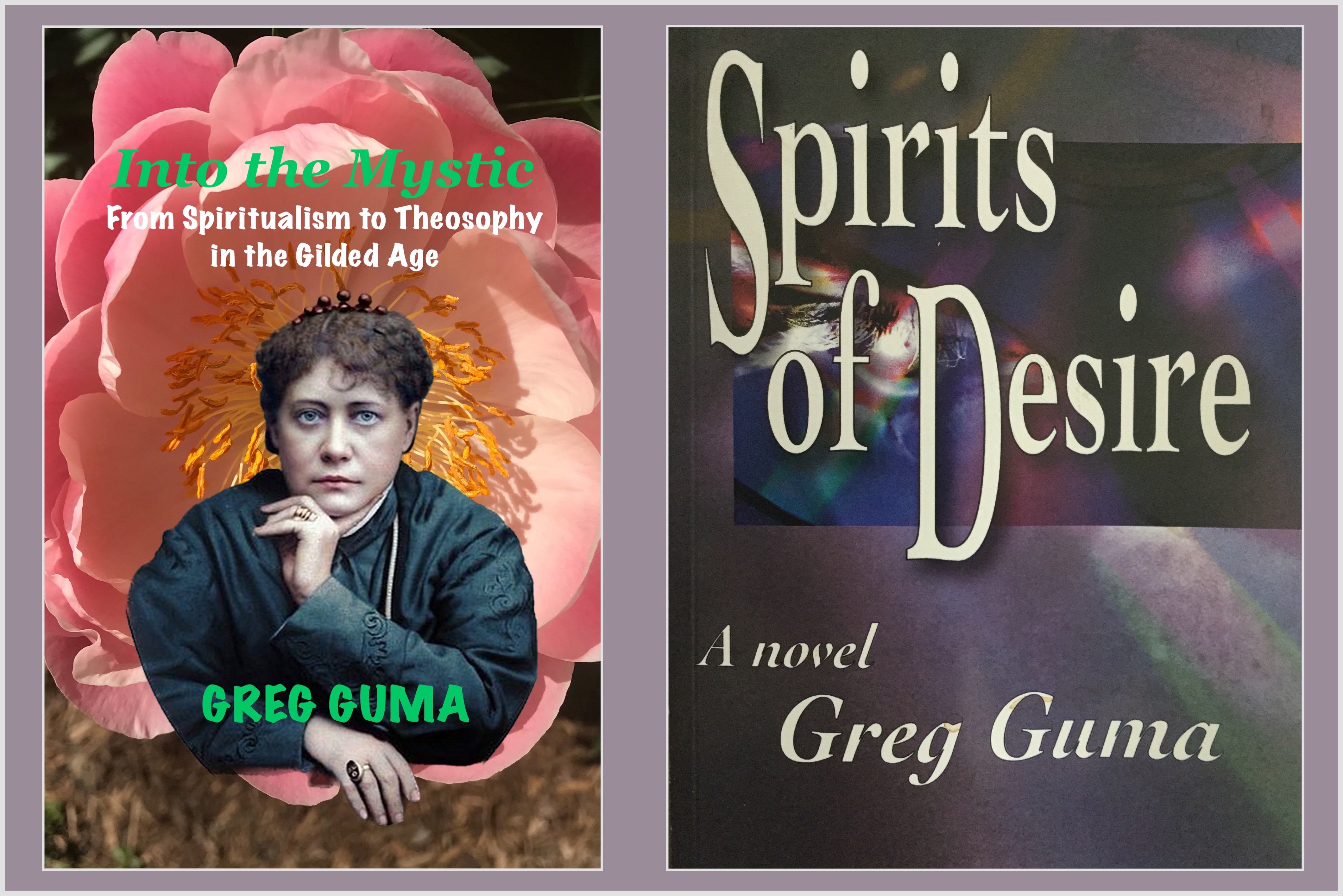
Into the Mystic explores the true story of how Helena Blavatsky and Henry Olcott did just that, and brought ancient Eastern wisdom to the West, creating the foundation for the modern New Age movement. Spirits of Desire, an historical novel, follows Blavatsky, Olcott and others as they search for the truth about ghosts, seances, elemental forces, astral projection and past lives. This is a basic introduction to the key historical figures and concepts discussed and explored in both books. A video interview and impressionistic montage follow the text. — GG


Orders: Into the Mystic Spirits of Desire


A woman of power with a special mission 

Helena Blavatsky


Helena Petrovna Blavatsky, eventually known as HPB, Jack and Madame,  left Russia in 1848, at age 17, in a bold escape from her marriage to a 40-year-old husband. Long before meeting Henry Olcott in Vermont, she had been around the world, often on her own, and absorbed the ancient spiritual traditions of Egypt, India and Tibet. 

She viewed her destiny as bringing the “secret doctrine,” a body of knowledge she also called occultism, Brahma Vidya, wisdom religion and Divine Magic, to a materialistic yet psychically fertile western world.

After serving in Garibaldi’s army, and a brief second marriage in Russia, she left her homeland for good. Eventually landing in New York in 1873, at the instruction of unseen spiritual masters, she drew together a circle of admirers and followed the spiritualist craze until she read one of Henry Olcott’s accounts about the Chittenden mediums. 

This was karma, she thought. He would be her partner in the “great work.”


A grieving journalist looking for ghosts

Henry Olcott


By the 1870s, Henry Steel Olcott, a retired colonel, had shifted his focus from corruption in naval yards during the Civil War to the study of mediumistic phenomena. He launched his career as Agriculture Editor for the New York Tribune, but made his name covering John Brown’s execution. 

After the war, he investigated government fraud and built a successful legal practice in customs and insurance, moonlighting as a lobbyist. He’d even been asked to uncover an alleged conspiracy surrounding Lincoln’s assassination. But none of it really interested him. Henry was disillusioned and in mourning. 

He made two visits to Chittenden, Vermont in 1874. Attending many seances and witnessing manifestations, he reported nightly materializations of “spirit forms” of all shapes and sizes and hearing music played by disembodied hands. He also obtained copies of what he called spirit writing.


A troubled medium haunted by his past

William Eddy 


William Eddy was born in Weston, Vermont in 1833. At age 13, he and his family moved to Chittenden, a township with less than 800 people at the western edge of the Green Mountains. 

His mother Julia Ann was psychic, able to foretell the future and communicate with the dead. She hid her abilities for years, fearing her husband’s reaction. But the birth of her first son ended that deception. Although William resembled his father physically, his arrival had revived Julia’s clairvoyant abilities. And her powers were inherited by her son.

By 1874 he was one of the most gifted mediums in the country. He was also a wounded soul with secrets in his past.


A cynical doctor determined to expose them 

George Beard


Dr. George Miller Beard graduated from Yale College and studied at the New York College for Physicians and Surgeons. After serving in the Civil War, he established a New York City practice, specializing in nervous diseases. He was one of the first to experiment with electricity as a stimulant, and used “central galvanization” to treat skin diseases. 

In 1874, he initiated a study of “animal magnetism” and spiritualism, convinced that such phenomena were tricks or delusions. That October, he visited the Eddy farm to “observe” a seance. Using a disguise, he got into the Circle Room with his “scientific” device. 

The plan: to connect electrical current to a ghost.


Seances


In 1870 estimates of spiritualists ran as high as eleven million, almost a third of the US population, many of them desperate to know what happened after death. In parlors and farmhouses they consulted mediums and attended seances to find out.

By 1874, the Eddy family’s seances in Chittenden were famous, their farm a pilgrimage site for just about anyone interested in contact with the dead. Henry Olcott made two visits, the second lasting more than two months, and published his findings in a major newspaper, The New York Graphic.

Attending seances and witnessing manifestations in a large, second floor Circle Room, he reported many materializations nightly —huge Native Americans, spouses and children, businessmen in expensive suits, even the departed Julia Ann Eddy.


Astral Projection


Spirits of the dead rarely return or communicate with the living, responded Helena Blavatsky, who also attended seances in Chittenden and met Henry Olcott there. Instead, she said, the materializations were “usually the astral body or double of the medium or someone present.” In other words, astral projection. A medium like William Eddy was a passive vehicle, she said. His mind was attracted by the “astral light,” his body in a trance. 

Today, between 8 and 20 percent of people claim to have had an out-of-body experience at some point — the sense that consciousness, spirit, or the “astral body” is leaving the physical body.


Elemental Forces


When someone dies, according to Helena Blavatsky’s Theosophy, life, the physical body and the astral body separate and vanish. But the essential being awaits reincarnation in the Kama-Loka, an astral realm with no boundary, sometimes known in mythology as Hades or the Underworld.

 Nearer to the material plane, elementals are also waiting. They are fluidic astral phantoms, formless entities with no sense of morality, attracted to mediums, hoping to “live” again by proxy, and assuming different shapes with the help of sensitive individuals or groups. For a short period they experience a vicarious existence, speaking, even acting through their human hosts. 

Some elementals don’t know what they are talking about, Helena warned, but “others are most dangerous, and can only lead one to evil.”


Karma


Karma is destiny, an enveloping web that each person weaves over a lifetime. People plan and create their own, good and bad, and the Law of Karma adjusts the effects. 

Helena Blavatsky sometimes described it as the Law of Retribution, others call it the law of cause and effect. If someone is suffering, choosing not to help when possible is bad karma. In the end, you’re really hurting yourself. 

Karma can come instantly, later in life, or after reincarnation into another life entirely. It also determines when and how you come back, thus affecting future existence. Good intent and good deeds create good karma and better rebirth. 

 Over time, the word has generally come to mean “what goes around comes around.” 


Past Lives


The idea that human beings live many lives before reaching perfection has been around for centuries. Helena called it metempsychosis. It’s also known as reincarnation, rebirth, and transmigration. 

The last term had a drawback in the 19th century: it suggested that a human being could regress to a lower form from life to life. According to Theosophy, “once a human being, always a human being.” 

The purpose of life is spiritual emancipation, said Helena, and the soul reincarnates according to the Law of Karma.

In Spirits of Desire, Helena and William Eddy are karmically linked. To save him she must take him into a past life — their time together before the French Revolution — to heal an ancient wound.


Helena Blavatsky’s Impact


Within a year of meeting in Vermont, Helena and Henry founded the Theosophical Society in New York, developing chapters worldwide over the next quarter century and deeply influencing spiritual leaders like Annie Besant and Jiddi Krishmamurti; philosopher Rudolf Steiner; poets W.B. Yeats, T.S. Eliot and Wallace Stevens; inventor Thomas Edison; transformative leaders like Mahatma Gandhi, Jawaharlal Nehru, and Augusto Sandino; and artists Wassily Kandinsky and Piet Mondrian. 

She gradually initiated Olcott into the “secret doctrine.” After a tumultuous and controversial career she died in London in 1891. Blavatsky was the first Russian (actually born in Ukraine) ever to become a naturalized American citizen.

Many consider her the godmother of the New Age movement.


What is Theosophy?


Theosophy became part of 19th century vocabulary with the establishment of the first Theosophical Society in New York. During its first years, the two founders built a movement by focussing more broadly on the reintroduction of ancient wisdom and rituals from successive cultures, civilizations and epochs. 

Helena said the concept of theosophy came from second century Alexandrian philosophers, although the word itself is a compound of the Greek theos (god) and sophia (wisdom). Or, as she put it, “Divine Wisdom.” 

The theosophical movement was rooted in a few basic beliefs. There is one absolute, incomprehensible and infinite essence, said Blavatsky, “the root of all nature, and of all that is, visible and invisible.” Humanity’s “eternal, immortal nature” is a radiation of what she called the “Universal Soul.” The most important aim was “the relief of human suffering under any or every form, moral as well as physical,” she wrote. “And we believe the former to be far more important than the latter.”

Helena also explained that “ a true Theosophist must put in practice the loftiest moral ideal, must strive to realize his unity with the whole of humanity, and work ceaselessly for others. Now, if an Occultist does not do all this, he must act selfishly for his own personal benefit; and if he has acquired more practical power than other ordinary men, he becomes forthwith a far more dangerous enemy to the world and those around him than the average mortal.”


In the Circle: An Impressionistic Montage

Spirits of Desire: An interview with the author on educational TV (RETN)