Tuesday, January 5, 2021

Battling Truth Decay: A Social Virus Can Also Be Deadly

Corruption of truth has been contributing to social division and civic decay for years. Yet there are few consequences for peddling lies and paranoia, intentionally confusing speculation with fact, or perpetrating a vile premeditated hoax.

By Greg Guma

Conspiracy theories. They used to be good fun, provocative dinner table conversation and the focus of action movie plots. They were like certain parts of the body. Everybody had them and, most of the time, no one got hurt.

But that’s no longer true. Now believing in conspiracies can get people killed— like thinking a virus infecting millions is just more fake news— or cause confusion and havoc at the very least.


2019 Podcast

According to the FBI — itself the focus of considerable theorizing —  “conspiracy theory-driven domestic extremists” associated with the QAnon conspiracy theory are now officially a “domestic terror threat.” What’s QAnon? Also known as The Storm, it’s a secretive network that believes in a deep state conspiracy against President Trump, and also in Pizzagate, a related theory that a pedophile ring including Clinton associates was run out of the basement of a Washington, D.C., pizza restaurant — which didn’t actually have a basement.

Forget Jeffrey Epstein. These are the real perverts. Epstein is just another deep state victim. That’s how this thinking works.


Back in reality, supporters of QAnon have been linked to multiple threats, attempted acts of violence, even murders. And Trump has amplified Q messages dozens of times on Twitter. Just days before he destroyed part of downtown Nashville and killed himself last week, the Christmas Day bomber sent packages containing writings and videos promoting conspiracy theories to multiple people.


In October 2017,  QAnon jumped to the mainstream in the form of shirts and signs that were prominently visible at a Trump campaign rally in Tampa, FL. After that Trump met with several supporters of the conspiracy theory — at the White House. A QAnon supporter co-chaired a coalition group for Trump’s reelection campaign, and several believers have since been elected to Congress. In 2021, they are challenging the legitimacy of the last presidential election.


Do more people buy into conspiracies today? Or is it mainly more media coverage? Either way, for most of the last 50 years, between 60 and 80 percent of the country has believed in some form of JFK conspiracy theory. They’re obviously not all “conspiracy nuts.”


On the other hand, conspiracy thinking did cross over in 2016 — probably with foreign help — from Internet chat groups to mainstream news coverage. For example, a Yahoo News podcast, aptly named "Conspiracyland,” revealed that Russia’s foreign intelligence service was the origin of a hoax report that tied the murder of Seth Rich, a Democratic National Committee staffer, to Hillary Clinton. Washington police concluded that Rich was killed in a botched robbery. There was no proof that his murder had any political connections. But many people believed there were.


Among the violent conspiracy theories cited by the FBI is one involving a man who thinks Transportation Security Administration agents are part of a New World Order elite. Another focuses on the High Frequency Active Auroral Research Program (HAARP), a government-funded facility in Alaska that has been linked to everything from death beams to mind control. (See Podcast Extra for more on HAARP.)


Whatever the truth about HAARP, two men were arrested in 2019 for “stockpiling weapons, ammunition and other tactical gear in preparation to attack” the Alaska facility. They believe it is being used “to control the weather and prevent humans from talking to God.”


Source: Reliable Sources/CNN


In response to the spread of conspiracy-motivated violence, the FBI is applying the same radicalization analysis it has used against foreign terrorism. They essentially focus on the ideological motives. FBI Director Wray claims that the Bureau is only concerned with violence, not with what people believe. 


But the number of extremist categories has certainly grown. According to Michael German, a former FBI agent with the Brennan Center for Justice, “It’s part of the radicalization theory the FBI has promoted despite empirical studies that show it’s bogus.”


“They like the radicalization theory because it justifies mass surveillance,” the former agent claims. “If we know everyone who will do harm is coming from this particular community, mass surveillance is important. We keep broadening the number of communities we include in extremist categories.”


But this argument is also, basically, a conspiracy theory. And that’s the problem. It’s increasingly hard to tell which ones to give credibility.


Not all conspiracy theories are dangerous. Even the FBI admits that much. Some may even be benign. But others have led to attempted or successful violent attacks. The Pizzagate conspiracy, for example, led a 28-year-old man to invade a Washington, D.C., restaurant to rescue the children he believed were being kept there and fire an assault-style weapon.


Or the related, overarching Deep State conspiracy theory. The FBI cites an unnamed California man, arrested in December 2018 after being found with what appeared to be bomb-making materials in his car. He was allegedly planning to “blow up a satanic temple monument” in the Capitol rotunda in Springfield, Ill. Why? To “make Americans aware of Pizzagate and the New World Order, who are dismantling society.”


The FBI’s intelligence analysis doesn’t mention Alex Jones or InfoWars by name. But it does include some of the conspiracy theories frequently associated with him, especially the New World Order theory. Jones claimed the Sandy Hook Elementary School shooting, in which 26 children were killed, was a hoax, a false flag operation intended as a pretext for the government to seize or outlaw firearms. The families of a number of victims sued Jones for defamation, saying his conspiracy-mongering contributed to death threats and online abuse.


Following the conspiracy trail a bit further, you quickly come to President Trump, who promotes a number of theories. Here’s a short list: He often talks about the Deep State, and frequently retweets output from QAnon. He’s the godfather of Spygate, which alleges that Obama and others wiretapped him, and a big pusher of the voter impersonation lie, aka the existence of millions of phantom voters. There is also white genocide theory, baked into his output, and of course, the Obama citizenship theory — which launched the movement that launched his presidential candidacy.


Yet it’s highly unlikely that the FBI will be investigating Trump for peddling conspiracies — no matter who they hurt — even after he is no longer in power. Instead, Michael C. McGarrity, the FBI’s assistant director of the counterterrorism division, has told Congress that the bureau now classifies domestic terrorism threats into four main categories: 


* racially motivated violent extremism 

* anti-government/anti-authority extremism 

* animal rights/environmental extremism, and

* abortion extremism, used to classify pro-choice and anti-abortion extremists


The new focus on conspiracy theories falls under the broader category of anti-government extremism. And that’s a slippery slope.


A decade ago, the most successful right wing conspiracy theory involved Obama as a secret Muslim. Before Trump piled on, millions of people already believed it. They also believed that secular humanists wanted to repress religion, and that liberals were plotting to confiscate people’s guns and push a “gay agenda.” All of that set the context for Trump’s election.


At the other end of the ideological spectrum, however, there is the idea that 9/11 was an inside job — and all that entails. On the first 2021 broadcast of Meet the Press, Chuck Todd raised that theory from the conspiracy graveyard, comparing the idea to Sen. Ron Johnson’s allegations about election fraud. Tit for tat.


In the past, I’ve been called a conspiracy theorist myself —for example, for saying that we should know more about the attack on the Twin Towers. Nevertheless, I also think that a modern-day Reichstag fire at multiple locations qualifies as a radical, somewhat implausible conclusion.


On the other hand, despite the fact that conspiracy theories can be distractions, even deliberate deceptions, some are worth consideration, as long as we stipulate that they aren’t necessarily 100 percent accurate, and certainly resist exaggeration or total buy-in. But some theories definitely pose a real and present danger as incitements to violence.


The problem is that it has become difficult for millions of people to tell the difference between the strange and the dangerous in an era when facts have been so seriously devalued. There are so many possibilities, the standard of proof appears to be in decline, and the theories tend to evolve, expand and mutate rapidly in unexpected ways as they circulate through cyberspace. There is often also too little follow up to see whether new facts reinforce or discredit a particular theory.

For several years, corruption of truth has been contributing to social division and civic decay. Yet there are few consequences for peddling paranoia, intentionally confusing speculation with fact, or perpetrating a premeditated hoax. Instead, more actors are weaponizing these things to expand or hold onto power.


For all the false prophets, gross opportunists, and irresponsible rumor-mongers who currently threaten societies with truth decay, real accountability has been hard to get so far. But we do know who many of them are. 


So, how about this as a start? Let’s call them out, publicly, maybe even post their names on billboards, banner ads, and Trump’s Great Wall of Lies down at the border. And on the wall, please make the names big enough to be seen from space. Then let’s all stop listening to them.


Podcast Extra: REALITY CHECK

Let’s keep things in perspective — if that’s possible in such a confusing world — with a look back. Here’s some of what I observed on the same topic about ten years ago:


I usually resist the urge to challenge the controversial theories of fellow travelers, at least in public. Years ago, during an after-dinner discussion about Al-Qaeda after Osama, someone casually asserted that President Roosevelt knew about the attack on Pearl Harbor in advance and let it happen. No one objected or said a word. I thought about it, but let the moment pass.


Anything’s possible, right? Why be rude? But some theories and predictions are just too important. They are widely accepted as indisputable and part of an overall world view, usually linked with an anti-establishment ideology. They have practical consequences for social action, can spark deep divisions, and influence how people see and treat others. In some groups, if you question the conclusions of a prevailing theory you’re either a dupe or a collaborator.

Deep skepticism is often at the root, a good thing in general. After all, so much of what we once believed has turned out to be a lie, or at least a very selective version of reality. But still, shouldn’t there be standards? Also, why do some theories get all the attention while others, perhaps more credible ones, get buried? And can’t we at least call people to account when their claims repeatedly lead down false trails?

In 2004, when friends claimed that George W. Bush would invade someplace – probably Cuba – before the election, I was skeptical but said nothing. Four year later, when colleagues embraced the idea that either a) there would be a pre-election invasion – Syria this time, or b) federal troops would be used to install Bush as dictator and block Obama’s election – in short, Martial Law was imminent – I took bets.

In 2011, word spread in activist circles that the rise in US Drone strikes and NATO helicopter attacks inside Pakistan were harbingers of something bigger. The war was going to be extended into Pakistan with the ultimate goal of seizing that nation’s nuclear weapons. Turns out they went after Osama, although many people believe that is also a lie and bin Laden was killed years earlier. 

These death conspiracies sound like the classic one about a fake moon landing – we never went there, right? – including phony video and a staged photo of the National Security brain trust looking at…what? Seal Team Six on a Top Secret movie set?

But speaking of plots, depopulation has been getting some attention, specifically related to the use of covert technology to allegedly cause earthquakes and tsunamis. (Which bring me back to HAARP — The High Frequency Active Auroral Research Program, a joint military program involved in classified experiments involving the ionosphere.) 

The basic claim is that it has been involved for decades in developing various types of weather-based and environmental warfare capabilities. It doesn’t help that the military has a name for this kind of thing – weather modification. (That’s why the two men were stockpiling ammunition for an attack.)

Still, using HAARP to cause earthquakes, wipe out regions and thin the herd is something else. The theory went like this: Supporters of the depopulation theory say Haiti was a transparent example, and claimed as evidence that a US task force was ready to invade before the earthquake occurred. And before that came the Indian Ocean tsunami, where people weren’t warned as soon as possible. Afterward came Fukushima, a full-scale assault not only on Japan, but on the oceans and atmosphere.

“The established pattern, with disasters and invasions, is incremental escalation,” explained a friend who supported the theory. Nuclear reactors in the US are therefore sitting ducks, just waiting for a HAARP attack. “And they have made it clear that an 80% reduction in world population is their goal,” he explained. Who made it clear? The overseers of the New World Order. Them.

Early in 2011 a rumor also began circulating that Wikileaks was a CIA plot. The idea was that the leaks actually supported the US imperial agenda around the world. In short, Wikileaks was a US intelligence con job that would be used to crack down on the Internet and advance a long-standing anti-civil liberties agenda. 

Evidence used to support this idea included the shutting down of Wikileaks servers in the US and the 2009 introduction of S. 773, The Cybersecurity Act, which, if it had passed, would have given the president the power to disconnect private-sector computers from the Internet. We dodged a bullet there.

The problem was that, while the Wikileaks-CIA plot looked even then like a distraction, the Department of Homeland Security had actually begun to seize and shut down web domains without due process or trial. The focus was sites that supposedly “violate copyrights.” But the risk was that cyber censorship could be extended to, let’s say, combat alleged cyber terrorism.  A very slippery slope.

After several more websites were shut down, DHS held a hearing on the move to give the President more authority over the Internet during an emergency. Senate Homeland Security Committee Chair Joe Lieberman noted that China “can disconnect parts of the Internet in case of war and we need to have that here too.” In this context, the Wiklieaks-CIA story may have been an attempt at disinformation, one that didn’t go viral.

(Additional comments from the August 8, 2019 podcast) 

Friday, December 11, 2020

Early Bernie Encounters: “I’d make a good candidate”

VIDEO: Before the Revolution 

(From the Vanguard Press 1980)

Early Bernie Encounters: “I’d make a good candidate”

From articles by Branco Marcetic & Marc Fisher, with notes by Greg Guma


A few months before Bernie Sanders’ 2020 campaign for President hit an insurmountable roadblock and a pandemic shut down the country, I sat down in person with Branco Marcetic of Jacobin, a good-looking socialist magazine. Like other researchers before him, during both of Bernie’s historic presidential runs, he wanted to discuss how the remarkable rise to power began forty years earlier. His account, released as a series in December 2019, opened with what Bernie told me when we sat down, back in November 1980, to talk over the upcoming race for Burlington mayor:


I think I’d make a good candidate.” Yes, that’s exactly what he said.


It had been a little over a week since Bernie Sanders decided to run for mayor of Burlington. Now, with these seven words, he was trying to ward off a rival challenger.


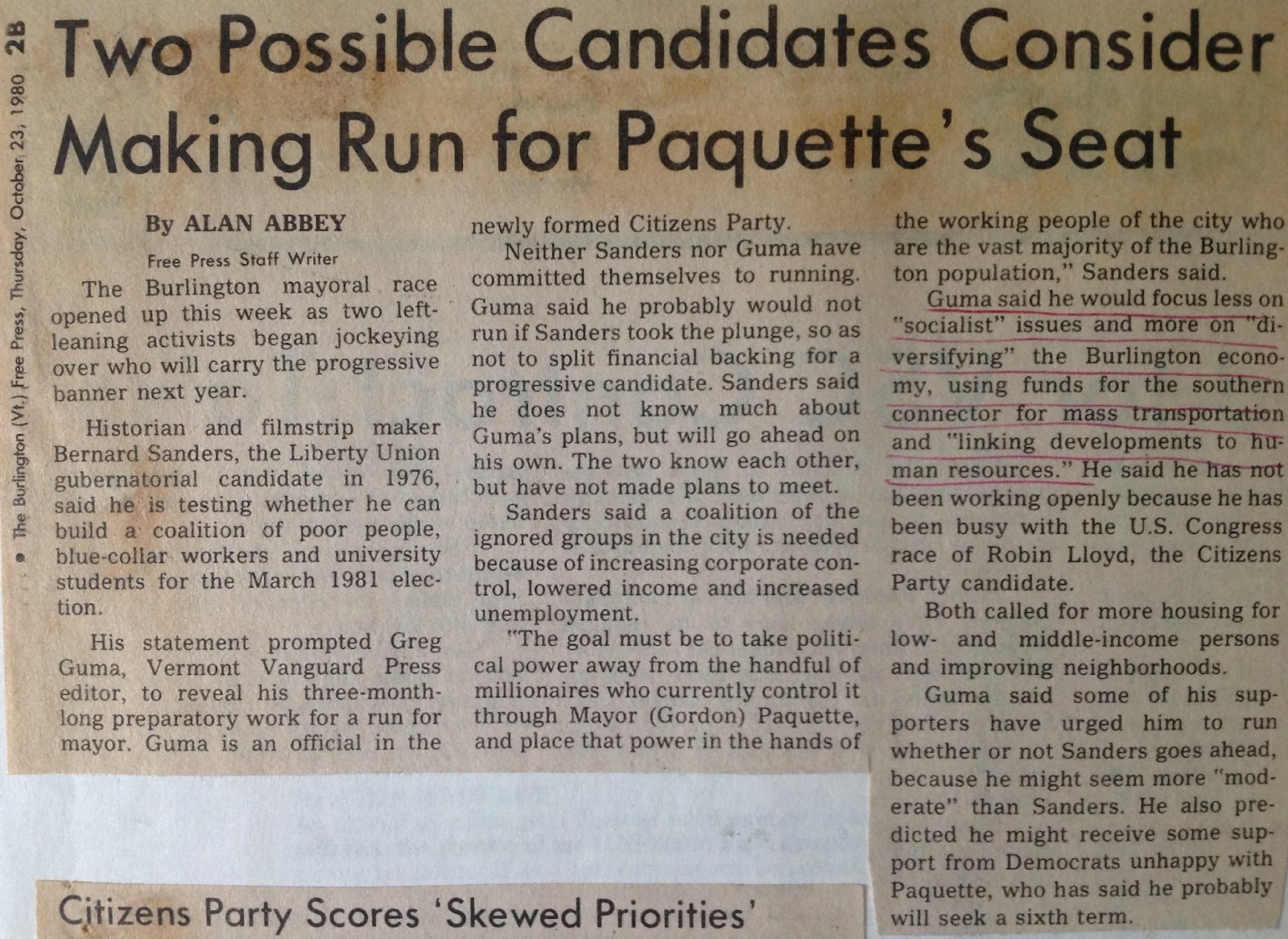
The man he was trying to persuade was Greg Guma, fellow left-wing activist and journalist whose own quiet plans to run had been unexpectedly outed by the Burlington Free Press a week before Sanders made his Halloween night decision to launch his own. The two had first crossed paths during Sanders’s 1972 Senate run, when Guma made the mistake of asking Sanders to tell him about himself. That meeting had concluded with Sanders brusquely telling Guma he didn’t want his vote.


Eight years later, upon learning of Guma’s plans to challenge five-term incumbent Gordon Paquette, Sanders phoned him and arranged a sit-down. The two met downtown in Burlington’s Fresh Ground Coffee House — long a place of interest in the FBI’s investigations into local “extremists.”


As Guma recalls, the meeting was less a conversation than a “test of wills.” Over the course of the meeting, Sanders made clear he would be going forward with his campaign no matter what. Guma could either step aside or split the progressive vote and likely sink them both.


For Guma, the choice was easy, if unpalatable. His highest priority was smashing the city’s staid political establishment, and he already had a job editing a weekly paper, one he was likely to lose if he ran for mayor. Sanders, by contrast, had no job and was a natural politician, a confident speaker able to connect with voters and adept at turning every question and topic to his stock talking points. 


Guma officially bowed out on November 11, telling the Free Press he didn’t “really want to be in a position of dividing progressives looking for an alternative to Paquette.” But his frustration at letting Sanders head a movement he had played a leading role over the preceding years in building was clear. “I don’t think he represents what the majority of people want,” he told the paper.


Today, Guma says the episode encapsulates something about Sanders’s leadership style. “He makes his own decisions, he only consults with a few advisors, he trusts his gut, and once he makes the decision, you’re not going to make him change it,” he says. “Ever.”


Sanders, for his part, made clear to the public he would be playing to win this time. “What I don’t want people to believe is that this is a similar effort” to his Liberty Union campaigns, he told the press. He saw his campaign as a mini version of the political revolution that would become a staple of his speeches.


“The goal must be to take political power away from the handful of millionaires who currently control it through Mayor Paquette, and place that power in the hands of the working people of the city,” he said.


And unlike his Liberty Union campaigns, Sanders would eschew talking about national issues and foreign policy, focusing instead on building a voter coalition through speaking to local needs and issues. Before he could do that, however, he would have to figure out exactly what those were.


In Part One of the series, “The Bernie Sanders Origin Story,” Marcetic also explained:


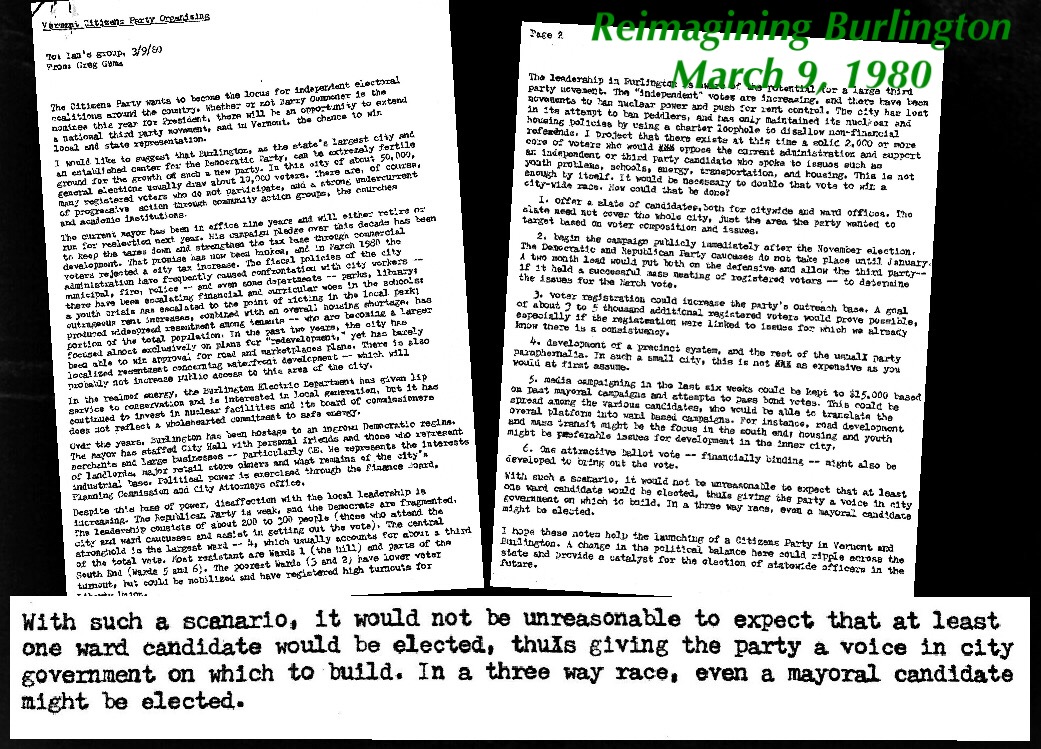
Guma, then editing the alternative weekly Vanguard Press, saw possibilities in Barry Commoner’s Citizens Party. In March 1980, he wrote a memo to Ian Laskaris, a former Democrat and early Vermont organizer for the Citizens Party, arguing that Burlington could be “extremely fertile ground for the growth of” a third party. 


Outlining the city’s copious sources of resentment, he noted the growing influence of Burlingtonians unaligned with either major party, and noted that the city’s two poorest wards, while registering the lowest voter turnout, “could be mobilized and have registered high turnouts for Liberty Union.” Suggesting several strategies to bring nonvoters out, Guma predicted that “it would not be unreasonable to expect that at least one ward candidate would be elected,” and that “in a three-way race, even a mayoral candidate might be elected.” 


There was another good omen. By the time the 1980 election was over, the party’s House candidate, peace activist Robin Lloyd, ended up with 13 percent of the vote, including 25 percent in Burlington. Robin and I were co-parents of a two-year-old son, Jesse, and I had urged her to run. You can see the 1980 strategy memo further down in this article.

Decision in a laundry

This was hardly the first version of my pattern of stormy encounters with Bernie Sanders. I had written about them originally in my 1989 book, The People’s Republic. But six months before Marcetic and I spoke, just as Bernie was rising in the polls, Washington Post editor Marc Fisher tracked me down while unearthing crucial new details in Bernie’s origin story that were news to me. 


Fisher’s June 13, 2019 feature began with this revealing scene:


On Halloween night in 1980, in a dank laundry room of a public-housing project in his adopted hometown, Bernie Sanders’s friends sat him down for a serious talk about his future. He had none.


Not if he kept going as he had for the previous decade. Sanders readily conceded that, having run for Vermont governor, twice, and for U.S. Senate, twice, never winning more than 6 percent of the vote, he risked getting stuck on the fringe, perceived as a joke.


The future presidential candidate was 39 years old and lacked even the beginnings of a career. He drifted from apartment to apartment and ended up having to leave one place because he was so behind on his rent. He had trouble connecting with the people around him. Without a steady job, he drove around the state in his Volkswagen Bug trying to sell teachers the films he had cobbled together about socialist Eugene V. Debs and other radicals.


What brought him satisfaction was diving into the battlefield of ideas. He loved to talk about how to improve life in America, and he was good at it. People left his speeches fired up, affirmed.


As he entered a second decade of campaigning, Sanders wanted another shot at running for governor.


No, his closest political pals said. Richard Sugarman, a philosopher who taught existentialism and Jewish thought at the University of Vermont, joined with three other allies and urged Sanders to give up on fruitless statewide races and target instead a place where he might actually win — Burlington. I still wonder who the others were, and whether one of them was also working inside my campaign.


Sugarman had run the numbers. Although Sanders never came close in any of his 1970s campaigns, he had pulled double digits — well, 12 percent — in the state’s largest city. He had done well in Burlington’s lower-middle-class neighborhoods. People there liked what he had to say.


Sanders was blunt: He knew little about city issues, couldn’t see himself as the guy in charge of snow removal.


But the others insisted that a mayor could focus on matters Sanders cared about: City residents were struggling to make their rent, and nothing was closer to Sanders’s heart than the plight of the ordinary worker. A mayoral campaign could tap Sanders’s passion for preaching about how the rich and powerful were the main obstacle to equality. He could battle the city’s Democratic political machine and big-business leaders


They talked through the night. As dawn neared and the workers who lived in the Franklin Square project began trickling in to wash their clothes, the men in the laundry room pressed for an answer. Sanders repeatedly said he wanted to focus on big, systemic change. But he also wanted to break out of his identity as a perennial also-ran.


He would run for mayor.


He had one last question for his friends.


“What the hell would I do if by some miracle I won?”


Even decades later, I had no idea this was the true backdrop for Bernie’s decision until Fisher’s article appeared. In the same story he also revisited how Bernie and I originally met, as well as our fateful showdown eight years later:


In 1971, Sanders showed up at a Liberty Union meeting at which the party was choosing its candidate for U.S. Senate. Nobody else seemed to want to take on the task. Sanders did. He got the nod, simple as that. Off he went, making the case against a rigged system, railing against big companies, Wall Street and the political parties that served as their enablers.


The purpose of that campaign and those that followed was “mainly educational,” said John Franco, who ran for lieutenant governor on the Sanders Liberty Union ticket in 1976. “Nobody knew who we were. Standing outside a GE plant in Rutland at shift change, Bernie was introducing me to the workers and nobody knew who he was either.”


Sanders slammed Democrats and Republicans alike, telling audiences that major-party candidates “can’t talk about this, because the people with the money will punish them.”


“I don’t follow those rules,” Sanders would say.


Or many others. The first time fellow activist Greg Guma met Sanders, at a meet-the-candidates event in 1971, Guma asked what in Sanders’s background made him the right man to be senator.


“Obviously, you haven’t been listening to me,” Sanders replied, as Guma recalled it. “Do you know what the movement is? Have you read the books? Are you against the war in Vietnam?”


Of course, Guma said, “but you’re a person, not a movement.”


“It’s the movement that’s important,” Sanders insisted. “Are you for it?”


It’s not only about policy, Guma said: “You have to prove you’re a basically good person if you want my vote.”


Sanders had heard enough: “I don’t want your vote,” he said.


“We used to say, ‘He’s a jerk, but he’s our jerk,’ ” Guma said.


Liberty Union members couldn’t decide between being a debate society and dedicating themselves to winning elections.


Some members were acolytes of a political philosopher named Murray Bookchin, an anarchist who lived in Burlington and was a pioneer in the U.S. ecology movement. Bookchin saw Sanders as an accommodator — far too willing to work within the existing system


“If socialist he be, he is of the ‘bread-and-butter’ kind whose preference [is] for ‘realism’ over ideals,” he wrote in a slashing critique in 1986. Bookchin, who died in 2006, dismissed Sanders’s “unadorned speech and macho manner” and “the surprising conventionality of his values.”


In hours-long arguments about Murray vs. Bernie, Bookchin would say, “You have to break with Bernie because he is a pragmatist,” Guma recalled. “He felt Bernie was selling out.”


By 1977, Sanders and some of his friends had had it. They left Liberty Union. “People got tired,” Abbott said, “of sitting in meetings debating ideas over and over again.”


In the years before his mayoral campaign, Sanders seemed to drop out of the political scene, according to several people who were close to him. He spent time on friends’ couches, made films, wrote for leftist papers, taught a bit, did some carpentry and house painting.


“I don’t remember him ever having a job,” Guma said. “Bernie felt like a lost soul in that time, a person who didn’t fit in exactly.”


But Sanders never seemed terribly concerned about his tenuous existence. “He’d say, ‘That’s just the way the world is,’ ” Terry Bouricius recalled.


A crucial endorsement

In March 1980, Guma wrote a memo urging fellow members of the Citizens Party, a third party that was considering running candidates in Vermont, to focus on Burlington.


The city “can be extremely fertile ground,” Guma wrote. Financial woes, cronyism between the Democratic mayor and business leaders, unrest among youths, soaring rents — the city’s troubles made it ripe for political upheaval. “In a three-way race, even a mayoral candidate might be elected,” he wrote.


Sanders was organizing low-income residents of Burlington’s Franklin Square housing project, bringing college students, the elderly and the poor together to press for affordable housing and tenants’ rights.


Guma, then editing an alternative newspaper, planned to run for mayor, but he realized that if leftists had any chance of pulling off an upset, only one of them could be on the ballot.


Some activists urged Guma to be that candidate. They considered Sanders great at reducing complicated topics to plain English, but they saw him as a pragmatist — and that was no compliment.


Guma and Sanders met to suss out each other’s plans. “Bernie said, ‘I’m running,’ ” Bouricius remembered. “ ‘This is not an educational campaign.’ ” He was in it to win it, and he needed a clear field.


Guma figured that “if I ran, I’d probably lose my job. The owner of my paper didn’t want me in politics. Bernie didn’t have anything to lose — no job. And he’s 6-2 and I’m 5-5, and that makes a difference.”


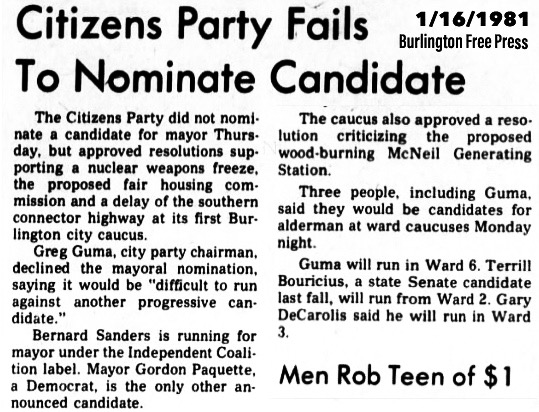
Guma stood down. But his theory about Burlington proved right.


Going up against the city’s five-term Democratic mayor and a local restaurateur, Sanders won the endorsement of the city police union. His door-to-door campaign — always telling residents, “We’re here to listen to complaints” — got its big boost after he promised a pay raise to the city’s police officers, whose income had been frozen by Burlington’s mayor.


“That turned him from a fringe candidate to somebody who could actually be mayor,” Guma said. “Once the police supported him, he couldn’t be a real red.”


Sanders slipped into office by 10 votes. He would go on to spend nearly three decades in Congress, in the House and then the Senate, but his four terms at city hall remain his only executive experience.


The rest, as they say, is history.