Showing posts with label Elections. Show all posts

Friday, November 6, 2020

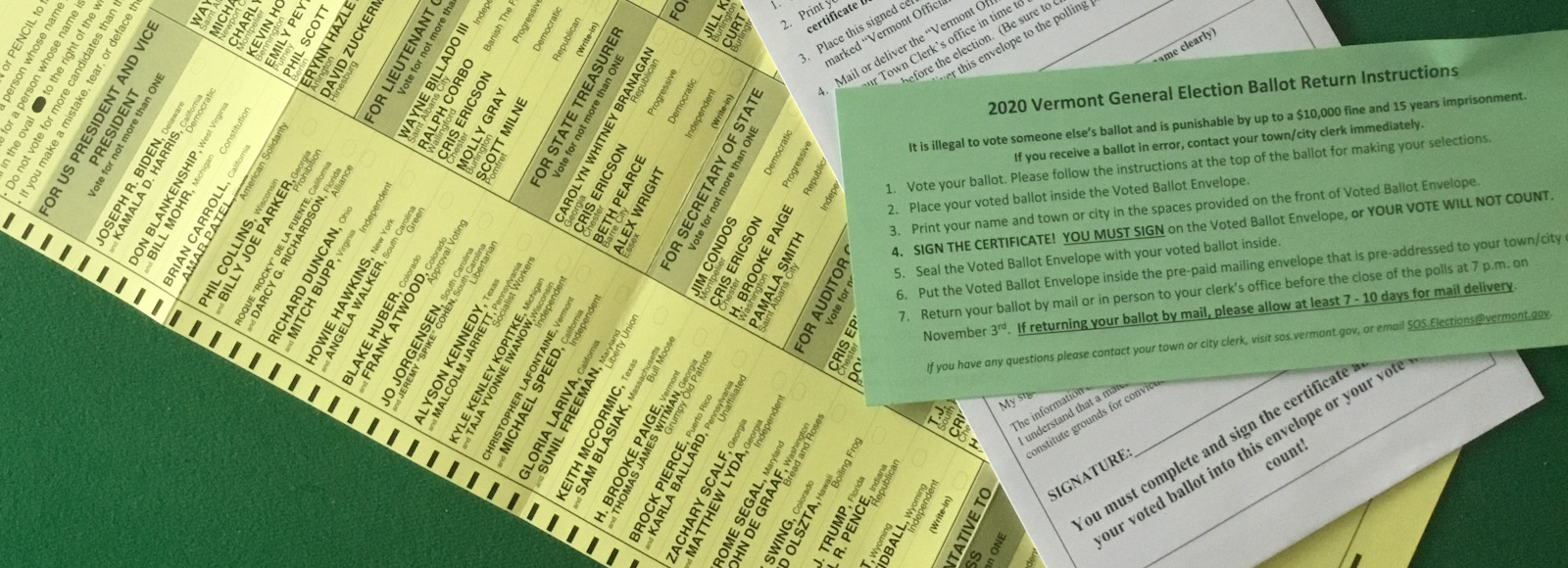
Presidential Turnout: 21 Hopefuls Sought Vermont Votes


In 2020, as of October, 1,216 candidates had filed papers with the Federal Election Commission to run for President. And due to Vermont’s open approach to ballot access, the state’s voters were able to choose from an impressive 21 of them. Those candidates hailed from 16 states and represented a mind-blowing array of parties and ideas.

Trump Platform: “We’ll see what happens.”

Everyone knows the winner by now — Democratic war horse Joe Biden (242,820 votes, or 65%, in Vermont), who represented Delaware in the US Senate for decades until becoming Obama’s Vice President, and the sore loser, Donald Trump (112,704, 30%), a developer and reality TV personality who irritated New Yorkers for decades until moving to Florida, running for President, and winning the right to offend everyone for four years. 

Those Post-Victory Blues: Commentary Link 

The national race was a nail-biter, but the Vermont outcome was hardly in doubt. Vermonters went for every Republican presidential candidate from 1860 to the 1980s. Even FDR couldn’t break through. Since 1988, however, the state’s electoral votes have gone to every Democratic candidate. That didn’t change in 2020. 

But the predictable state outcome provided an opportunity to win “conscience” votes for some other hopefuls — 16 men and three women — competing for Vermont’s presidential votes. Several chose to be listed as Independents, but most represented political parties, some old, some new, with wildly diverse histories and political agendas. 


Let’s see how they did. The most popular turned out to be South Carolina Libertarian Jo Jorgensen (3,608 votes, just shy of 1%), the Green Party’s Howie Hawkins (1,310), and Wyoming-based Independent Kanye West (1,269). The only other candidate receiving more than 1,000 votes was H. Brooke Paige, the Grumpy Old Patriot candidate from Vermont (1,164).


Nationally, Jorgensen — the only female candidate on the ballot in all 50 states — came out on top. Her estimated 1.6 million votes (1.2 %) is the second-highest total for the party in its half century history.


Here are the rest, with their home states and the Vermont votes they received: Christopher LaFontaine, Vermont, Independent (856 votes); Richard Duncan, Ohio, Independent (213); Brian Carroll, California, American Solidarity (209);  Don Blankenship, West Virginia, Constitution (208); Alyson Kennedy, Texas, Socialist Workers (195); Gloria Estela La Riva, California, Liberty Union (166);  Gary Swing, Colorado, Boiling Frog (141); Phil Collins, Wisconsin, Prohibition (137); Keith McCormic, Vermont, Bull Moose (126); Brock Pierce, Puerto Rico, Unaffiliated (100); Jerome Segal, Maryland, Bread and Roses (65); Blake Huber, Colorado, Approval Voting (54); Kyle Kenley Kopitke, Michigan, Independent (53); Rogue “Rocky” De La Fuente,  California, Alliance (48); and Zachary Scalf, Georgia, Independent (29). 


Better luck next time. Fortunately, there will be one. Meanwhile, who were these hopeless hopefuls? 


Five Party People

Jerome Segal of Maryland, represented the Bread and Roses Party (65 votes). Segal is an American philosopher and political activist from Silver Spring. A research scholar at the University of Maryland and president of the Jewish Peace Lobby, he was a candidate in Maryland’s Democratic primary for the US Senate in 2018. During that year, Segal also announced the creation of a new socialist political party, "Bread and Roses," after raising the 10,000 signatures required by the state’s Board of Elections. The party is named after a slogan used by striking workers during the 1912 Lawrence textile strike. To find out more: https://www.segalforpresident.org/

Howie Hawkins is an American trade unionist, environmental activist, and frequent candidate in New York. A co-founder of the Green Party of the United States, he was was also its 2020 presidential candidate (1,310 votes). The GPUS is a federation of state political parties that promotes green politics, specifically environmentalism; nonviolence; social justice; participatory, grassroots democracy; gender equality; LGBTQ rights; anti-war; anti-racism and eco socialism. It was formed in 2001 as the Association of State Green Parties (ASGP) after a split from the Greens/Green Party USA (G/GPUSA) in the late 1990s. After its founding, the GPUS became the primary national green organization in the country, eclipsing the G/GPUSA, which was formed in 1991 out of the Green Committees of Correspondence (CoC), a collection of local green groups active since 1984. For more information: https://howiehawkins.us/

Joanne Jorgensen, candidate of the Libertarian Party, (3,608 votes) is an academic and libertarian political activist from South Carolina. She was previously the Libertarian Party's nominee for vice president in the 1996 presidential election, as the running mate of Harry Browne. Libertarianism is often thought of as 'right-wing' doctrine. However, on social — rather than economic — issues, libertarianism often tends to be 'left-wing'. If any alternative party has an enduring base in Vermont, this is apparently it.

Libertarians share a skepticism of authority and state power, but diverge on the scope of their opposition to existing economic and political systems. The Libertarian Party promotes civil liberties, non-interventionism, laissez-faire capitalism, and limiting the size and scope of government. For more: https://jo20.com/

Don Blankenship, who ran as the Constitution Party candidate, is a West Virginia business executive (208 votes). A candidate for the US Senate in West Virginia in 2018, he was Chairman and CEO of the Massey Energy Company, the sixth-largest US coal company, from 2000 until his retirement in 2010. In December 2015, Blankenship was found guilty of one misdemeanor charge of conspiring to willfully violate mine safety and health standards in relation to the Upper Big Branch mine explosion and was sentenced to one year in prison. 

The Constitution Party, formerly the U.S. Taxpayers' Party until 1999, promotes a right to far-right view of the principles and interests of the US. Its platform is based on originalist interpretations of the Constitution and shaped by principles that it believes were set forth in the Declaration of Independence, Constitution, Bill of Rights, and the Bible. For more: https://www.donblankenship.com/

Phil Collins, the Prohibition Party candidate, currently lives in Wisconsin. Collins has also been active in local politics in Illinois and Nevada (137 votes).  In 2019, he ran in Las Vegas' mayoral election and came in second. On April 14, 2019, he was given the Prohibition Party's vice presidential nomination after initially losing the presidential nomination to Connie Gammon, the original 2020 vice presidential nominee after Bill Bayes withdrew from the presidential nomination. On August 24, 2019, he replaced Gammon as presidential candidate after she withdrew due to health problems. Afterward he announced that he would also run in the American Independent Party’s presidential primary in California. 

On March 3, 2020, Collins won that primary. However, the party elected to give its presidential nomination to Rocky De La Fuente and its vice presidential nod to Kanye West. Both are also candidates for president on the Vermont ballot. The Prohibition Party has nominated a candidate for president in every election since 1872, making it the longest-lived American political party after the Democrats and Republicans. For more: https://philcollins4president.weebly.com/

Three California Dreamers


Brian Carroll, the American Solidarity Party candidate (209 votes), taught junior high history and other subjects in Farmersville, California from 1977 to 1983. At the time, he also wrote for the Valley Voice newspaper, especially on the local need for public transportation. He taught nine years in Colombia, South America and one summer in China. In 2008, he returned to teaching in Farmersville. Carroll ran for California's 22nd congressional district in 2018 against Republican Devin Nunes and Democrat Andrew Janz, a contentious race due to Nunes' role in the Trump investigation. 


The American Solidarity Party (ASP) is a Christian democratic political party founded in 2011. It emphasizes "the importance of strong families, local communities, and voluntary associations."  Socially conservative, the party defends religious freedom, favors a social market economy, and seeks "widespread economic participation and ownership,” along with a safety net. Its platform calls for conservation and a transition toward more renewable sources of energy, while rejecting population control measures. For more: http://briancarroll.life/


Rogue “Rocky” De La Fuente was on Vermont’s presidential ballot representing the Alliance Party (48 votes). A businessman and perennial candidate, he was the presidential nominee of both the Reform Party and his self-created American Delta Party in 2016.  In 2018, De La Fuente was on the ballot in nine states' primaries for US Senate. He campaigned as a critic of President Trump’s immigration policies. This year, he entered Republican primaries, but secured the nominations of the Reform Party, the Alliance Party, and American Independent Party.  


The Alliance Party was formed on October 14, 2018. In December, the American Party of South Carolina successfully asked the state Election Commission to change its name to the Alliance Party. In May 2019, the Independence Party of Minnesota voted to affiliate with the Alliance party. The Independent Party of Connecticut also affiliated, and the Alliance Party became ballot qualified in Mississippi. For more: https://rocky101.com/en_us/en/


Gloria Estela La Riva, a presidential candidate on Vermont’s Liberty Union Party line (166 votes), is a California-based socialist activist with the Party for Socialism and Liberation (PSL) and the Peace and Freedom Party. This is her tenth consecutive candidacy as either a presidential or vice presidential candidate. This time she is running on the PSL, Peace and Freedom, and Liberty Union tickets. La Riva was previously a member of the Workers World Party. She ran as the PSL and Peace and Freedom Party presidential candidate in 2008 and 2016. The PSL is a US communist party established in 2004 after a split in the Workers World Party. For more: https://www.lariva2020.org/


Two Rocky Mountain Party Builders


Blake Huber, the Approval Voting presidential candidate (54 votes), hails from Colorado. He worked in the telecommunications industry until his retirement, and is a co-founder of the party, which focuses on advocating for a voting system that allows people to select multiple candidates. In 2018, the party ran Huber for Colorado Secretary of State. It was recognized as a minor party in Colorado in 2019. For more: http://www.approvalvotingparty.com/president-blake-huber/


Gary Swing, a 48-year-old cultural events promoter in Denver, was on Vermont’s presidential ballot as the Boiling Frog candidate for president (141 votes). Swing originally filed FEC paperwork to run for US Senate in Colorado as a member of that party. Boiling Frog is more of a ballot label for his independent U.S. Senate bid than a national political institution. That said, according to coverage of Swing’s candidacy in the Bennington Banner, Boiling Frogs are concerned about global warming and stovetop warming, amphibian rights, preservation of endangered species, water pollution, and conservation of wetlands and other natural habitats. It makes sense. For more: https://theswingvote.wixsite.com/unity


I could go on, but you get the idea; a candidate for almost every conscience.


Still, lest we forget, also on Vermont’s presidential ballot you would have found... from Texas, Alyson Kennedy, representing the Socialist Workers Party (195 votes; 40 years ago Bernie Sanders was one of its electors), and Keith McCormic, leading the Bull Moose Party (126 votes); from Vermont, H. Brooke Paige, representing the Grumpy Old Patriots (1,164 votes) and an Independent, Christopher LaFontaine (856 votes).


Speaking of Independents, Vermonters also had the option of voting for Wyoming’s Kanye West (1,269 votes, who led the field with some assistance from Jared Kushner), Ohio’s Richard Duncan (213 votes), Michigan’s Kyle Kenley Kopitke (53 votes), Georgia’s Zachary Scalf (29 votes), or Puerto Rico’s Brock Pierce (100 votes), a candidate so independent he was listed as Unaffiliated. All totals are the unofficial ballot results from the Vermont Secretary of State.


Vermont Results


Vermont Digs Doug: With 265,088, Vermont’s top vote-getter turned out to be State Auditor Doug Hoffer. He even topped the 248,205 votes cast for incumbent governor Phil Scott, a moderate Republican (no, they’re not extinct). Of course, it helps not to have a Republican opponent. (What’s up with that?) Doug is a straight shooter and a Vermont public servant for more than 30 years. 


The remainder of the Auditor votes (over 48,000, or 15%) went to Progressive candidate Cris Ericson, which will allow the Progressive Party to maintain major party status. Ironically, Ericson — who won five(!) Progressive primary races — ran as a supporter of Donald Trump, who won only 30% of the Vermont vote. 


The most disappointing outcome was David Zuckerman’s 99,066 votes (27.46%) in the governor’s race. Like Hoffer, Zuckerman is also a member of Vermont’s Progressive Party. It was a heavy lift, and Vermonters don’t usually reject a governor after just one or two (two-year) terms, especially during a crisis. (Scott has had two terms.) But it also suggests that Vermont’s Democratic coalition may not hold together for a candidate with mixed party loyalties. The last time we saw an outcome like this was 2004, when former Progressive Mayor Peter Clavelle got 38% running as a Democrat against incumbent Republican Jim Douglas.

Friday, October 4, 2019

Those Watergate Blues: Presidential Party Crashing

By Greg Guma

Impeachment. It’s the word of the year, maybe the decade. But for some of us it’s not the first time. Twenty years ago, Bill Clinton was impeached — but not removed from office — for oval office intern sex. For Democrats, it was relatively easy to condemn the sex and lying under oath, yet reject the idea that it warranted conviction. Afterward, the biggest impact was the subtle damage it did to Al Gore’s 2000 presidential campaign. 

Twenty five years before that, Richard Nixon resigned and waved goodbye. But he wasn’t impeached. He was merely threatened. Nixon had been caught running a private gang of political thugs. He had weaponized agencies and obstructed Congress until the evidence became overwhelming. Trump has already made that look trivial.

But I’m thinking past impeachment. Believe of not, Trump won’t be president forever. And although his departure will certainly be great TV, after that there will be smarmy claims that the system had worked after all, and that now things will return to normal. Doubtful, very doubtful. After Nixon was gone, and especially after his hand-picked successor Gerald Ford pardoned him, a deep disillusionment set in. Unfortunately, we’re headed there again. 

In 1974, while attending graduate school at the University of Vermont, after watching the Watergate hearings for months, only to have Nixon and Ford sidestep accountability and undermine justice, I was in a funk. Then I heard that Ford would be visiting Vermont. Here’s what happened, sort of.... on the night I went presidential party crashing.

Listen to "#8 Watergate Blues" on Spreaker.

October 7, 1974. Burlington, Vermont

The Republicans ate roast beef. That was one of the facts I wanted to verify. Along with another vital piece of information: President Gerald Ford wore mismatched socks. According to rumors, each morning he picked them out himself.

George and Gerry
When I finally did find out Ford was sitting just above me, tucked behind the dais in Patrick Gymnasium. He had flown to northern New England to honor retiring U.S. Senator George Aiken, past dean of the Congress. Ford ate his beef and vegetables in silent tribute.

I was crumpled with my camera beneath his table, only inches from his blue and green socks. Awed. Or was I dreaming? Anyway, about midway through the meal I pulled on Ford’s leg. He passed me a potato and continued to chat with Aiken and the other Republicans. I tugged again and he leaned down, ostensibly to retie his shoelace.

“Is Chile really your Watergate?” I asked.

“You’re lucky I’m a friend of the free press,” he replied. “Hey, you want some sour cream?”

A few hours earlier, I had watched Secret Service men search reporters at the Vermont National Guard base at the airport. The concrete walkway near the planes had become a frisking ground by 6 p.m., an hour before the arrival of Air Force One. As a local photographer reassembled his lenses, the blond agent who had done the frisk leaned over him, checking each film canister. The SS man looked like an Ivy leaguer who had just joined the mob.

Flashing a press card I edged past them. The card was four years out of date. Then a rock-hard voice froze me in place: “PLEASE. MOVE. BEHIND. THAT. FENCE.”

The face connected to the icy warning looked like tooled leather left out in a snowstorm. I smiled, shrugged, and began to focus my Pentax on the whole team of government studs.

Leather Face noticed and immediately turned friendly. As much as he wanted to help out, he said, he simply could not let me through without the special white pass that I might obtain at the gym. At the gym, however, I discovered that only ten Vermont and ten national press people would be allowed to actually see the president. And all of them had been cleared by the SS a week earlier. Of course, a $50 contribution for dinner and speeches provided automatic clearance. It was the good old days.

After dinner, Aiken rambled on for about 2,000 stuffed contributors. The meal had been prepared by university food service. Yum. Aiken opined that this was the largest group of Americans who had ever eaten apple pie together. A veritable patriot’s Woodstock.

Personally, I was hungry and unmoved, still brooding over my rejection from the press pool. Yet I had managed to slip into the gym shielded within a bunch of tipsy Burlington politicians singing “Hail to the Chief” as we passed the check point. Before dinner I had ducked underneath the dais and crawled to the front of the hall.

When a pair of legs invaded my hideout I peeked up to see. Wings of karma, I thought, the President! The man otherwise known to the demonstrators outside as Nixon’s revenge. A light tug at his cuff let him know I was there. He leaned down and asked, “Is that you, Kennerly?” I held up my camera but admitted that I was not actually his personal photographer. But no threat intended, I explained. My paper, Metesky’s Monthly, was looking for a softer, personal angle.
Betty Ford at Bennington College

Ford was sympathetic. During the appetizer we talked about his wife, who had an old relationship with Vermont. Years ago she had spent a summer with a dance troupe at Bennington College. Betty had arabesqued across the lawn with Martha Graham, picking up some wild ideas along the way. Ford was happy to share. But he declined to comment on the specific nature of the wild ideas one picks up at arts schools.

While he ate more pie I reviewed my encounter with the SS men. Pretty tight on the reins for a man of the people, I complained to the president. “Whatever happened to openness and candor?”

Ford beckoned me with an index finger just below the line of the table cloth. I edged forward and he silently smeared the remains of his pie into my face with a smile. “Pass interception,” he said.

Apparently, this meant “openness and candor,” one of Nixon’s empty pledges, had officially become “fun and games.” That said, the pie was fine.

It had already been quite a night, beginning with protesters on a dying lawn in front of the Ramada Inn. A 20-foot neon sign above us announced, WELCOME PRESIDENT DORF. An act of gentle vandalism.

Cop cars zipped back and forth on the nearby commercial strip. A circle of chilled demonstrators stamped around the grass, carrying signs, chanting to bemused motel visitors and assorted gawkers at the Red Barn. The center of this dissent was about two dozen cloaked actors led by Julian Beck, founder of the Living Theater. They had come to speak out about Chile and Vietnam and Amnesty (for draft resisters, not Nixon) and Rockefeller (the appointed Vice President) and the ghost of San Clemente.

Beck was a gangly apparition, long grey hair streaming to his shoulders. Cast members wore black and death head makeup. In a monotone chant they announced, “Ford, Ford, it’s too late, Chile was your Watergate.”

But something was missing. Call it authentic enthusiasm. Tear gas or helmet-wearing oppressors might have provided the needed jolt of adrenalin. As it was, the Living Theater created a dramatic form, but not much drama. Snake-lining beneath red dragon fabric they formed a totem pole frieze, then shouted some truisms about fascism, capitalism and other isms that ought to be abolished. Not many others present took up the chants. 

As they continued another old slogan popped into my mind. If only they had added, “Two, four, six, eight, organize and smash the state.” But that was an outdated sentiment in what looked like an era of enforced tranquility. 

The Living Theater indicted power and authoritarianism, taunting the oppressors to reveal themselves, a message they often delivered with powerful gestures. I had last seen the group in 1968 when their radical production, “Paradise Now,” toured the country. In Vermont they had stopped at Bennington College and told the college women:

                        We’re not allowed to take our clothes off.
                      We’re not allowed to smoke marijuana.
                      We’re not allowed to travel without passports.

Then they urged their audiences to violate these norms. Or at least to disrobe. Eventually it often became a demand from a growing crowd of naked people. In 1974 it was still not permitted to undress or smoke grass in public. Yet the chants no longer felt as liberating. 

The performance ended after dusk, but the picketing continued until a black limo carrying the Commander-in-Chief whizzed into the parking lot. The crowd, much larger now, surged forward to a path blocked by more cars and cops. Siphoned back to the front entrance, they regrouped and restarted their chants. But the point of the demo was becoming obscure. Why protest Ford? What did he represent, except possibly physical fitness in middle age and a warped sense of team spirit? 

As if to echo my thoughts, one of the marchers asked, “How can you hate a banana?” That sounded about right. Gerald Ford was indeed a strange political fruit, one with a tough, slippery skin that probably concealed a soft inside.

“I don’t think I’d want as much recognition as you’ve got,” joked Aiken to laughter and applause. Roasting Ford after desert the old senator sounded like a wizened Georgie Jessel, complete with one-liners and weathered Vermont anecdotes. For example, Aiken praised Ford for doing more to restore cooperation between Congress and the executive branch than any other man “in the same amount of time.” The amount — about two months.

As Aiken surrendered the podium Ford leapt to his feet. This would probably be my last chance for an exclusive interview, so I yelled, “President, sir, what I really want to know, what America is asking itself, does all this clapping hurt your hands after a while?”

Realizing that he didn’t plan to answer I grabbed Ford’s leg, which sent one shoe skittering across the gym floor. An SS man quickly jumped up from the front table and splayed himself over the threatening footwear.

“Good save,” said Ford. Then an aside, “You get used to this sort of thing after a while.”

During his speech I learned quite a lot. Here are two of the many insights: 1) When elected officials talk the warm up should be at least as long as the speech itself, and 2) To be effective a politician should establish a firm connection with the place being visited.

Ford’s connection to Vermont dated back to October 2, 1965. On that evening, after another dinner and speech, he met a Republican grandmother who had missed the event and asked about his talk.

“Oh, that was nothing,” Ford demurred.

The grandmother replied, “That’s what I heard.”

Was it true? Who cared. The self-deprecating joke launched him into ten minutes of Thank You shout outs and misty recollections. He had come to help us celebrate Aiken Day. “He cuts through the chaff,” Ford said, explaining in a phrase the connection between politics and advertising. Politicians are like cleaning liquids. “Is chaff getting you down? Spoiling your weekends? Causing unsightly demonstrations? Try Aiken.”

But Vermonters couldn’t buy anymore Aiken. He had taken himself out of circulation. Yet Ford was on the tribute train, and unfortunately some of his remarks supported the rumor that, after 30 years in Congress, Aiken was losing his mind. Oops.

Ford certainly had a way with words, praising the “breadth and depth and greatness” of Aiken. He also explained that the Vermont senator was the only man he knew who could “go into a store with one dollar for four pounds of sugar and come back with change.”

Aiken protested, “I am not a crook.”

After a while taking notes felt more like doodling than journalism.

Outside the gym about 500 people were hearing about other issues from a few Vietnam vets. They explained that about 200,000 people who were underground in the U.S. would not go along with the limited amnesty proposal offered by Ford. And they charged that Ford’s pardon of Nixon was a crime that violated the former president’s civil rights, not to mention just about everyone else’s sense of fair play. Third Party candidates also delivered remarks as the chilled audience bought soup at 10 cents bowl. 

Despite the weather the protest leaders were optimistic. They were building a broad people’s movement, they explained. Ford seemed to agree. But for the president this alternative political energy was a threat to the nation.
Still crouched beneath the dais my view was not typical. The demonstrators outside seemed preoccupied with strong leaders and thought these guys actually made things happen. If I had been helping with their protest platform, I would have suggested another plank: Boycott Them All. Nixon, Ford, Rockefeller, just stop talking about them. End authoritarianism — by overcoming the obsession with so-called strong men. They don’t make change. We all do.

By the time Ford got around to issues I was close to unconsciousness. Fortunately, there were only two issues on his list. He talked passionately about “public enemy number two.” This dangerous bandit was actually a movement, the increasing number of independent voters. He had grave fears about the health of the nation, and pleaded for protection of the two — not three, not one — party system. In other words, two’s company, three’s a revolution.

“The politics of America is bound up in the two party system,” Ford explained. Exactly, bound and gagged. The congregation listened solemnly to this sermon from the ultimate party man. 

His themes: stability, opportunity, and freedom. The second and third items were never mentioned again. But stability was an emotional circuit that produced enthusiastic applause every time the word was spoken. It was spoken more than 15 times.

“What exactly is it that you want for us Americans?” I whispered.

“Choice without chaos,” he said.

“What the hell does that mean?”

Ford explained, “We fell into the pattern of the two party system.” And a lucky thing we did, he added, since in countries with more than two parties there is chaos, instability and lack of direction. The choice is clear, he added with civics class simplicity. Loss of freedom with one party or chaos with many. And the problem with “many” was “splinter groups” that “lack imagination.”

I couldn’t write down any more of this. My cheeks were covered with tears. Now I understood the identity of “public enemy number two.” Ford was declaring war on the spirit of independence in the name of stability and order.

Better yet, this was Ford’s kickoff address for the 1974 mid-term elections. His target was clear and, due to technical difficulties in economic and government life, it would not be the Democratic Party. No, “public enemy number two” was Vermont’s third party, Liberty Union, which was running its strongest slate of candidates yet. They weren’t contenders for election. But the party’s viewpoint was starting to turn some heads. Alternative parties were emerging elsewhere around the country, some of them already influencing policies. Ford made it clear that, in his view, these new voices were poisonous thorns in the side of freedom.

Thus, he called on stalwarts from both sides of the aisle to crush the threat of too much diversity. After all, how could a legislature function if it had more than two aisles, or more than two answers to any problem? His rallying cry: “strengthen the twin pillars of democracy.”

“What’s wrong with three pillars?” I shouted.

He kicked me away and, without missing a beat, spoke a bit more about the two “great parties,” which “are not an end but a magnificent means.” 

Then on to “public enemy number one.” If you haven’t guessed yet, it was inflation. Ford promised that it would not be tolerated. I felt safer already. He also spoke of a two-pronged attack. He would call on 1) congress and 2) the people. For what? “To accomplish success, to win the battle and to maintain a growing economy.” Politics would become a team sport, one with mandatory participation and invisible referees. Helmets would be provided for all citizens.

The next day Ford’s two prongs became a ten-point program to “whip inflation now.” From the podium he asked Vermonters to “pull together on the political fabric.” And what would that require? Sacrifice.

Not again. I could feel a howl of pain across the nation. Haven’t we suffered enough? How about some amnesty for the rest of us? Or maybe another point in the inflation plan. This one could be modeled on the Soviet method of dealing with so-called psychotic patients. Put them to sleep for a few weeks.

These days we are all troubled patients. Maybe a sleep cure would actually have some positive inflation impacts. For instance, we’d save on gas. Many people would prefer that to another dose of sacrifice and responsibility.

But Ford wasn’t listening to me anymore. Instead, he was winding up his remarks with some nostalgia about the Continental Congress. After one session, Benjamin Franklin reportedly told a spectator, “We have given you a Republic, if you can keep it.” All it took, Ford added, was sacrifice and vision.

Clutching my stomach I bit at my Pentax lens. The audience rose to cheer as I rolled out onto the floor. The nearest SS man was hovering over me a second later. Grabbing my legs he began to pull me out of view. But the cheers and standing ovation had brought tears to Ford’s eyes. Turning philosophical, he winked at me, then said, “We have given you another Republican. But will you keep him?”

“Here are my press credentials,” I protested, “my references, good intentions. And I’m registered to vote!” They dragged me out anyway. “I came for the apple pie,” I shouted hoarsely before blacking out, “but the main course has made me sick.” 

... Did it happen? Mostly. And the reason the story comes to mind is that the same kind of thing could very easily happen again.

Monday, July 15, 2019

Through the Years with Bernie Sanders

We first met in late 1971 at a Meet the Candidates event in the home of a friend in North Bennington. Bernie was in his first race and already aiming for the top — the US Senate. I was a local Dept. of Labor counselor and job developer for unemployed teenagers and adults. And yet, before long we were having an argument. 

I wanted to know more about his background and Vermont issues. He thought it was all about “the movement” and capitalism, and ended up declaring he didn't want my vote.


Creating Real Change (Video preview)

BETWEEN THE LINES
WPKN, 3/25/2019, interview with Scott Harris 

As I recalled it years later in The People’s Republic, after listening to his analysis of monopoly power and national corruption, I asked Bernie about his personal history and views:

“Obviously, you haven’t been listening to me,” he replied. “Do you know what the movement is? Have you read the books. Are you against the war in Vietnam?”

“Yes,” I said, “but you’re a person, not a movement.”

“You don’t understand. It’s the Movement that’s important. Are you for it? If you’re not, I don’t want your vote.”

Explaining that I needed to know more about Liberty Union, his political party, and the candidates themselves proved useless. Sanders became increasingly frustrated with my equivocal attitude.

“I don’t need your help,” he said finally. “We don’t have to prove anything to you.”

“You have to prove you’re a basically good person if you want my vote,” I explained.

Sanders shot back, “I don’t want your vote.”

Despite that inauspicious start, I have voted for Bernie Sanders more than a dozen times in the 47 years since then, in races ranging from Mayor of Burlington to Congress and US Senate. And he has certainly become more willing to talk about himself. For a while, before he became Burlington mayor, he rented an apartment across the street. Only once have I actively opposed his candidacy, although we have definitely disagreed, sometimes publicly, about priorities and tactics.

Recent Stories
Bernie’s Red Vermont (Politico, June 13, 2019)
Is Bernie a NIMBY? (Mother Jones, September, 2019)
Working with Republicans  (Wall Street Journal, September, 2019)
  
In the 1970s, while I worked as a journalist, as well as for state and local government youth and anti-poverty programs, he ran for governor and US senator, supported unions and activist campaigns, and worked and struggled on as a film producer and freelance writer. We sometimes wrote for the same publications, and I once invited him to opine about mass media for a weekly newspaper I edited.

Among other things, he said that the owners of the TV industry wanted to “brainwash people into submission and helplessness” and create “a nation of morons.” 


In late 1980 we agreed to work together in Burlington's upcoming elections. I was still editing the Vanguard Press, an alternative weekly, while chairing the local branch of the new Citizens Party; he was a veteran of four statewide races and had recently formed an independent coalition in Burlington. 

We both wanted to run for mayor, at first. But he was battle-tested and a more natural politician, while I had a job that I enjoyed and wanted to keep. In the end we met privately to talk it over. Soon afterward I withdrew from the mayor’s race, instead joining him on a coalition ticket as a City Council candidate. He won by 10 votes, with 40 percent in a four way race. I lost with 42 percent in a two-way race and returned to the editor's desk. 

It was the start of multi-party politics in Vermont and led to the formation of the Vermont Progressive Party, the most successful alternative to the two majors in the country, electing local, legislative and statewide leaders — up to the level of lieutenant governor — for over 30 years. 

Throughout Sanders’ eight years as Burlington mayor we remained coalition allies, often working together, but also disagreeing when necessary on development and peace issues. At one point that meant he presided over my arrest (with many others) outside an armaments plant. Peace groups were protesting gatling gun production and pushing for economic conversion. He felt we were blaming the workers and should protest instead at a congressional office.

On the day of the sit-in, Sanders was sullen and conflicted. He argued with the Chief of Police about videotaping the protesters, but also criticized an attempt to defuse the situation by asking General Electric not to ship arms for the day. The night before the event he contacted me to warn that the chief’s assurance about no shipments was inaccurate. He had demanded that the company be told to conduct “business as usual.”

After four terms as mayor, Bernie was elected to Congress in 1990, after coming close two years earlier, and didn’t lose another race until the campaign for president in 2016. (Before that announcement, he had already competed for office 20 times, most in statewide races, won 14 of them, and participated in hundreds of debates and public forums.) Meanwhile, I went on to edit other publications, defend immigrant rights in New Mexico, run a bookstore in Southern California, and manage Pacifica Radio, the progressive listener-supported network.

Earlier, I mentioned the one race (so far) in which I didn't back Bernie. In 1986 he had been mayor for five years and saw a chance to run for governor. But the Democratic incumbent was Madeleine Kunin, who had been in office less than two years and was the state's first female chief executive. In the end, I couldn’t support Bernie that time and instead found myself role-played him in a private mock debate with Kunin.  

Recently, Michael Kruse focused on this period for a Politico cover story, particularly on the relationship between Bernie and Jesse Jackson, who ran for President in 1984 and 1988. By 1986, as Kruse explains, “the Rainbow Coalition that Jackson’s ’84 campaign had spawned had grown in power in Vermont. Sanders, who was running for governor, couldn’t ignore it. Nor, however, could the state’s energetic contingent of Jackson devotees avoid Sanders, considering the sway he had over progressives in Burlington and beyond. A symbiosis between the two outsiders started to materialize. Sanders didn’t join the Rainbow; he wasn’t much of a joiner, period. But he ‘realized the necessity of participating in broader coalitions if he was ever to take his vision beyond the city limits,’ progressive organizer and journalist Greg Guma of Burlington wrote in his 1989 book, The People’s Republic: Vermont and the Sanders Revolution. ‘He was looking to hold onto that base of support so he could challenge from the outside,’ Guma told me.”

As Bernie retired from his role as mayor  -- to prepare for the next chapter, national office -- I published a book about what had occurred and changed over the past two decades, The People's Republic: Vermont and the Sanders Revolution. In 1990, after defeat by Republican Peter Smith in a congressional bid, Bernie came back and won. That led to eight terms in Congress — before moving on to the Senate and, eventually, his presidential campaign.

In 1998, while working for another Vermont weekly, I interviewed Bernie privately about his philosophy and plans. By then he had made peace with the Democratic Party, often a target during his third party and Burlington years. But he could already envision a run for president and was certain he would "do well." 

Summing up his concerns in another era of scandals and corruption, Bernie explained, “You have two political parties that are controlled by monied interests. You have a corporate media. When you talk about consolidation, you are talking about oil and gas, banking, and perhaps most importantly, the media – where there are very few voices of dissent regarding our current position on the global economy."


“That gets to even the more fundamental issue – the health of American democracy," he said. "Do people know what’s going on? And how can they fight what’s going on? I fear that they don’t.”


One of Bernie's other frequent complaints is that his opponents don't take strong and unequivocal stands, that they are basically all the same while he is different, and that the current rigged game and level of inequality are "totally outrageous" and unacceptable. 

He is adept at sarcasm and irony — and does have an inside voice, but his main style is proudly declarative. Bernie effectively channels and expresses what feels to millions like righteous outrage. He can be brusque, but he also comes across as fundamentally honest. Athough even his fans gently mock his hair and age, most supporters respect and trust him. For many it feels like love. It boils down to one key attribute — authenticity.

In 1976, Bernie was the first "third party" candidate in Vermont to force his way into a statewide TV debate. He was running for governor for the second time. Seated between the Democrat and Republican, State Treasurer Stella Hackel (later Director of the Mint) and millionaire businesman Richard Snelling, he effectively conveyed the idea that there was little difference between them. It didn't win him many votes that time. But he made the point more effectively in the 1986 race against Kunin and Peter Smith. That time he got more than 15 percent, respectable for an independent. Four years later he was in Congress, after defeating Smith, the incumbent, as well as the Democrat in the race. 

Through all the races and years he has become adept at spinning virtually any question to repeat his carefully honed points, often without directly answering, and remains relentlessly on message. But he is ready to strike back, at the media, or even a member of the public, if he feels defensive or offended. I've seen him shut down a press conference when he doesn't like the way things are going. It happened again in 2011, the last time we were in a small room together. 

The topic was Lockheed Martin and its relationship to Sandia Labs, which he was welcoming to Vermont. 


In the mid-1990s, he had led the charge against $92 billion in bonuses for Lockheed Martin executives after the corporation laid off 17,000 workers. He called that “payoffs for layoffs.” In September 1995, after his amendment to stop the bonuses passed in the US House, Lockheed launched a campaign to kill the proposal. 


In 2009, he was still going after Lockheed in the Senate, calling out its “systemic, illegal, and fraudulent behavior, while receiving hundreds and hundreds of billions of dollars of taxpayer money.” By then, however, he had visited Sandia headquarters and come away eager to have a satellite lab in Vermont. 

At the end of 2010, ten days after the mini-filibuster that jump-started a “draft Bernie” for president campaign, Burlington Mayor Bob Kiss announced the results of his own Lockheed negotiations, begun at billionaire Richard Branson’s Carbon War Room. It took the form of a “letter of cooperation” to address climate change by developing local green-energy solutions. Lockheed later backed out. 

By 2011, however, Sanders was also supporting the Pentagon’s proposal to base Lockheed-built F-35 fight jets at the Burlington International Airport. If the fighter jet, widely considered a massive military boondoggle, was going to be built and deployed anyway, Sanders argued that some of the work ought to done by Vermonters, while Vermont National Guard jobs should be protected. Noise impacts and neighborhood dislocation were minimized, while criticism of corporate exploitation gave way to pork barrel politics and a justification based on protecting military jobs.

When Vermont’s partnership with Sandia was officially announced on Dec. 12, 2011, Gov. Peter Shumlin didn’t merely share the credit. He joked that Bernie was “like a dog with a bone” on the issue. But the launch ended abruptly after a single question about the city’s aborted partnership with Lockheed Martin. Before a TV reporter could even complete his query Sanders interrupted and challenged it. Lockheed is not “a parent company” of Sandia, he objected.

And then, as is often the case when faced with unwelcome questions, he declined to say much more – about Lockheed Martin or the climate change agreement Mayor Kiss had signed, the standards adopted by the City Council, the mayor’s veto, or Lockheed’s subsequent withdrawal from the deal. Instead, he turned the question over to the representative from Sandia, who offered what he called “some myth-busting.”

It was more like an evasion. All national labs are required to have “an oversight board provided by the private sector,” he explained. “So, Lockheed Martin does provide oversight. But all of the work is done by Sandia National Laboratories and we’re careful to put firewalls in place between the laboratory and Lockheed Martin.”

In other words, trust us to respect the appropriate boundaries, do the right thing, and follow all the rules. Moments later, Sanders announced that the press conference was over.

Despite such blind spots, Bernie can be quite appealing to white working class voters, and even to some conservatives. Hillary Clinton thought she was tweaking him in 2016 on gun issues; she was really playing into his hands. Sanders is certainly pragmatic and savvy enough to realize that being a bit “moderate” on a few issues (like guns, drugs and defense) can help, in the south and in general. During the 1981 campaign — his first victory — he ran against a large property tax increase being proposed by the mayor. At the same time he insisted that “large institutions” and the wealthy should "pay their fair share." It was a sweet spot he will attempt to find again. 

Running against someone like Trump, an alleged billionaire,  should make it even easier for Sanders to talk about oligarchy and define the race as the climax of an historic movement. He frequently talks about "making history." In many past mailings he has also referred to how powerful right wing forces are out to get him, something that has helped to keep his base motivated. And he has long defined his campaigns in stark but convincing terms — a choice between oligarchy or democracy. It is increasingly hard to disagree.


Before the 2016 race, I helped Seven Days develop an interactive timeline: Bernie’s Journey

2015-16 interviews include:

International Business Times: Bernie Sanders' Debate Plan