... and Why It Didn’t Work
BY GREG GUMA
BY GREG GUMA
 |
| Sanders in 1981 |
SPECIAL REPORT TO VTDIGGER.ORG — Long before any votes are cast for president, some Democratic thought leaders have made up their minds about at least one thing. Bernie Sanders is too risky to be the Party’s nominee. And this existential fear of the so-called “far left” is already producing questionable choices, not the least of which is a preference by most other candidates and officials to avoid a serious discussion of socialism.
Instead, Democratic nominees tend to reinforce the Right’s red scare tactics by defensively declaring themselves capitalists, or at least deep socialist skeptics. “It can never work, not in America’s heartland,” most appear to agree, unfortunately neglecting to mention Social Security, Medicare and other democratic socialist policies that have operated successfully for decades, in the US and elsewhere.
A notable exception is Pete Buttigieg, the Indiana mayor also running for president. In a high school essay he once praised Sanders’ for his “courage” in describing himself as a “socialist.” In fact, it won him the 2000 Profile in Courage Essay Contest, sponsored by the John F. Kennedy Library in Boston.
At the time, most Democrats even shied away from the word “liberal” like “a horrid accusation,” Buttigieg wrote. “Even though he has lived through a time in which an admitted socialist could not act in a film, let alone hold a Congressional seat, Sanders is not afraid to be candid about his political persuasion.”
And yet, as with George McGovern in 1972, other Democrats (and their TV surrogates) sound more concerned about Sanders and his agenda than another term for someone they claim to despise. With Trump in charge, after all, there is a clear opponent and target for organizing. With Bernie as the party’s candidate or — god forbid — president, things might actually have to change in fundamental ways.
A notable exception is Pete Buttigieg, the Indiana mayor also running for president. In a high school essay he once praised Sanders’ for his “courage” in describing himself as a “socialist.” In fact, it won him the 2000 Profile in Courage Essay Contest, sponsored by the John F. Kennedy Library in Boston.
At the time, most Democrats even shied away from the word “liberal” like “a horrid accusation,” Buttigieg wrote. “Even though he has lived through a time in which an admitted socialist could not act in a film, let alone hold a Congressional seat, Sanders is not afraid to be candid about his political persuasion.”
And yet, as with George McGovern in 1972, other Democrats (and their TV surrogates) sound more concerned about Sanders and his agenda than another term for someone they claim to despise. With Trump in charge, after all, there is a clear opponent and target for organizing. With Bernie as the party’s candidate or — god forbid — president, things might actually have to change in fundamental ways.
But Sanders has seen it all before, from the public trash talking to the secret smear campaigns, ever since his first victory.

Satirical Slander
The dirty tricks began right after the shocking election that made Bernie Sanders mayor in March 1981. Within days, a new “underground newspaper” was launched in Burlington. But you couldn’t get it at a newsstand, or anywhere public. And the content was designed to discredit rather than inform.
Named after the Gannett-owned Burlington Free Press, the daily in Vermont’s largest city, the Flea Press reached an “elite” audience in the hundreds on a weekly basis, or thereabouts. City officials and media received it in the mail. According to then Assistant City Clerk Patrick Sullivan, copies of the photocopied publication would arrive near the end of the week, in time to reach city council members before their Monday public sessions. It quickly became the water-cooler talk of the town.
The Flea Press came in “a legal-size manila envelope,” Sullivan recalled, “with sealed envelopes inside addressed to the individual aldermen.” The postmark changed every week. It was a little like how porn was delivered. Additional copies were distributed hand-to-hand inside City Hall, read and re-duplicated by the curious and amused.
When the City Council met that May, Allen Gear, a Republican on the Board, personally passed out copies from a stack in open view. And when he and Democrat Joyce Desautels charged that evening that Sanders was trying to advance “the Socialist Party” in Burlington, their rhetoric closely resembled the editorial line of City Hall’s new, unofficial house organ.
In the Flea Press world, most local media ranked near the top of an “enemies list.” Early issues roasted editors and reporters at both the Free Press and Vanguard Press, the alternative weekly renamed Rumpguard Press. Specifically, they were blamed for the defeat of “Gordon H. Pickett” (Paquette), the “luckless incumbent.”
In fact, the first issue charged that political reporters had conspired with the Free Press ad department “in electing the city’s first Marxist mayor.” In the second issue he got a name — Bern A. Sunder.
By April, mild lampooning had turned into serious, often nasty personal attacks. Long before Twitter, nicknames were a cruel and effective way to ridicule the new personalities in local politics. The most consistent target, beyond the mayor himself, was “Pritchard Sauersmail,” often described as “Deputy Mayor.” Most readers knew that the actual target was Richard Sartelle, a Sanders ally and local low-income housing organizer whom the new mayor was paying — out of his own salary — to act as a community liaison.
The anonymous editor-writer of the Flea Press, who often betrayed a visceral distaste for “Sauersmail,” even stooped to belittling his clothing, family and intelligence, while chiding City Councilors for failing to take away his “free office space plus telephone.”
Eventually, the attack went mainstream. After the Flea Press smeared “Sauersmail” in six consecutive issues, the Burlington Free Press echoed its stance with a call for his removal. An editorial supported the case by arguing, without evidence, that unnamed city employees might view the Sanders associate as an “unofficial deputy mayor.”

The difference in Burlington was the insider perspective. The author of the Flea Press knew too much about activities inside City Hall to be a complete outsider. The jokes and gossip focused sharply on about a dozen key people and groups closely allied with Sanders. Many people assumed that a city employee somehow had to be involved.
Battle lines were being drawn, and the issue that best exemplified the dynamic was the appointment of city officials — normally a mayoral prerogative, but subject to Council approval. Sanders wanted to replace six out of twenty key people, mostly through attrition. Yet, on reorganization day, his candidates were rejected without a single question about their qualifications. The unspoken message was that “stonewalling” would be the order of the day.
Burlington’s new “underground press” captured and amplified the hostility. Its targets ranged from a police officer renamed Jody Kreepso, stand-in for a Sanders supporter who had been demoted, to Governor Prinz Philip (Phil Hoff), who embraced the new political energy in the city. After a while, “old guard” city workers began to use the nicknames in public. On the phone one day, the Police Chief accidentally called a reporter by his Flea Press name.
Of course, Burlington’s “underground” also had friends, especially former Mayor “Pickett,” stalwarts like City Treasurer “Austin F. Lee” (Lee Austin), Police Commissioner “Applewater” (Antonio Pomerleau), and City Clerk “Francois Vagon” (Frank Wagner).
At first considered no more than a nuisance, the Flea Press gradually began to look more threatening. It was making red baiting acceptable. At times other media outlets even began to sound a bit like the publication that mocked them. When Sanders debated Council members about his proposed appointees, for example, The Burlington Free Press described them as a “tight cadre of comrades.”
There was no attribution for the loaded phrase, a not-so-subtle reinforcement of the notion that Sanders was running a “socialist administration.”
There was no attribution for the loaded phrase, a not-so-subtle reinforcement of the notion that Sanders was running a “socialist administration.”
“How the System Works”
Bernie Sanders was well aware of the low-level red scare underway in early 1981, and wasn’t eager for a fight so soon into his first term. But he didn’t dodge the issue either, and decided to offer some of his earliest public remarks about socialism — less than three months after becoming mayor — as part of a welcome for Andrew Pulley.
The 1980 presidential nominee of the Socialist Workers Party (SWP) visited the Queen City on May 21, 1981. Sanders had been one of Pulley’s electors in the presidential race. Now the former candidate was on tour to discuss a lawsuit filed by his party against the federal government.
Here are some of Mayor Sanders’ remarks that night, as recorded and transcribed by the SWP’s newspaper, The Militant:
The 1980 presidential nominee of the Socialist Workers Party (SWP) visited the Queen City on May 21, 1981. Sanders had been one of Pulley’s electors in the presidential race. Now the former candidate was on tour to discuss a lawsuit filed by his party against the federal government.
Here are some of Mayor Sanders’ remarks that night, as recorded and transcribed by the SWP’s newspaper, The Militant:
I’m sure most of the people here know that for the last forty years the Socialist Workers Party has — now admittedly — been harassed, informed upon, had their offices broken into, had members of their party fired from their jobs, and have been treated with cold contempt by the United States government.
And it’s very clear that the reason they have been thus treated is because of their ideas — ideas which are frightening to the people who own the United States of America.
And they are a threat, these ideas, they are a threat.
I think the point Andrew will probably deal with is also well known. In the fifties, with McCarthyism, they created a system of bugaboos, with the bugaboo of communism. Any person who stood up for working people, or for low-income people, or for peace, was associated with the “communist front.” Now the word is “terrorist.”
Now anybody who stands up and fights and says things is automatically a terrorist and to be associated with these people who plant bombs in buses, and murder children and innocent people.
I trust that many of you know how the system works. It happened slightly, in my case. Because I was an elector for the Socialist Workers Party, there was a “noninvestigation.” I was “noninvestigated” by the FBI. The theory is that it was an attempt to smear me.
I think there’s a way to deal with that terrible word — that pornographic word which they hate in this country — called socialism.
Sanders advised those who attended to be straightforward about socialism, but also to talk about democracy. “I don’t have to go out denying it,” he said. “Then we can have the debate which is the real debate all around the country. That debate is socialism versus capitalism. That is the debate of our century.”
“I think the best way is to be up front about that word,” he advised, “not to run away from that word. To deal with it in a straightforward way, and explain exactly what we mean by that word.” This is essentially what he has done as a presidential candidate.
“Along with Andrew,” he added, “we are antiauthoritarian. We believe in democracy.”
“Along with Andrew,” he added, “we are antiauthoritarian. We believe in democracy.”
 |
| Andrew Pulley in Burlington / The Militant / Harry Ring |
Speaking with Harry Ring, a reporter for The Militant, Sanders also said, “This garbage about people don’t want government. Of course people want government to do something for them. But they don’t want the kind of government they’ve been getting.”
“I think most people understand that there aren’t two parties. That there’s just one party called Republocrats, or Demicans, or whatever you want to call them.” But in Burlington, he added, “at least we’re bringing the word socialism into the realm of reality. It’s no longer some far-off business.”
Actually, the word was spreading as America’s only socialist mayor since the Depression fast became a national sensation. A clear sign was his July 1981 “appearance” in Garry Trudeau’s Doonesbury, in the form of an imaginary TV encounter with Tomorrow Show host Tom Snyder.
“Mr. Mayor, let’s be candid okay?” asks Snyder. “You’re a socialist. You’re a jew. You’re from New York. So how the heck’d you get elected?”
Bernie’s reply is typically blunt. “The people of Burlington wanted a change. They decided to send the capitalist system a clear message.” Then there’s a joke about France and the fringe benefits of being mayor.
Not everyone was so intrigued or accepting. A May issue of the Flea Press featured a poignant article by “Jeems I. Weezleson” (Free Press editor James Wilson), who revealed his yearning for the former mayor’s return:
“I think most people understand that there aren’t two parties. That there’s just one party called Republocrats, or Demicans, or whatever you want to call them.” But in Burlington, he added, “at least we’re bringing the word socialism into the realm of reality. It’s no longer some far-off business.”
Actually, the word was spreading as America’s only socialist mayor since the Depression fast became a national sensation. A clear sign was his July 1981 “appearance” in Garry Trudeau’s Doonesbury, in the form of an imaginary TV encounter with Tomorrow Show host Tom Snyder.
“Mr. Mayor, let’s be candid okay?” asks Snyder. “You’re a socialist. You’re a jew. You’re from New York. So how the heck’d you get elected?”
Bernie’s reply is typically blunt. “The people of Burlington wanted a change. They decided to send the capitalist system a clear message.” Then there’s a joke about France and the fringe benefits of being mayor.
 |
| Part of Garry Trudeau’s July 1, 1981 Doonesbury |
Not everyone was so intrigued or accepting. A May issue of the Flea Press featured a poignant article by “Jeems I. Weezleson” (Free Press editor James Wilson), who revealed his yearning for the former mayor’s return:
“In striking contrast to the mayor’s appearance was the presence of the Honorable Gordon H. Pickett, former Queen City mayor, and the association’s (Queen City Downtown Merchants’ Business Association) first annual award recipient. Senator Leamy (Leahy) was unstinting in his praise for the former mayor and the association seconded it by giving Pickett a ten-minute standing ovation.”
It was a slight exaggeration. Yet, having captured an underground base in City Hall, the Flea Press was turning anti-Sanders hold-overs and employees into its distributors. The format was refined a bit, a typeset masthead proclaimed it “A. Ginnit Newspaper,” and cartoons were added under the headline, “Goonsbury.” The content remained the same, a grab bag of gossip, labels and lies designed to anger and demean, a sophomoric merger of the National Enquirer and Harvard Lampoon.
People working in neighborhood groups were “residential hyper-active groupies,” roasted for either their looks or alleged moral failures. Predictably, the anti-Sunder majority on the City Council could do no wrong. In June, however, some concern was expressed in the Flea Press that the new mayor might get his appointees after all. “Sunder is counting on cupidity, middle-class stupidity, and terror tactics to crack the aldermanic front,” its editor speculated.
Perhaps this was a premonition. By August attitudes were indeed changing. A Republican, Robert Paterson, called the Flea Press “insulting and in bad form,” and Joyce Desautels, who once echoed its rhetoric, now considered it “a bore,” although she did like the cartoons. “Bern A. Sunder,” the “Queen City’s Marxist Potentate,” was still lampooned and labeled a “red.” But a new Enquirer-style obsession had emerged — the mayor’s personal relationship with “Jean Dripsoil” (Jane Driscoll).

Exposure and Realignment
For almost six months, theories circulated about who was behind the weekly slander sheet. It had to be someone close to city affairs, in fact someone who had mourned with the Democrats on election night. Close analysis of Flea Press content revealed attendance at budget meetings and other city functions, along with deep contempt for neighborhood groups and the local press.
But few knew the truth. That is, until a paste up of page two was left behind on a copier only blocks from City Hall.
At first pollster Vincent Naramore denied having left the page. “Well, did anyone see me do it,” he snapped when confronted. But absolute denial eventually became “I can’t remember” making copies on the day in question. And anyway, the Vanguard Press had the document.
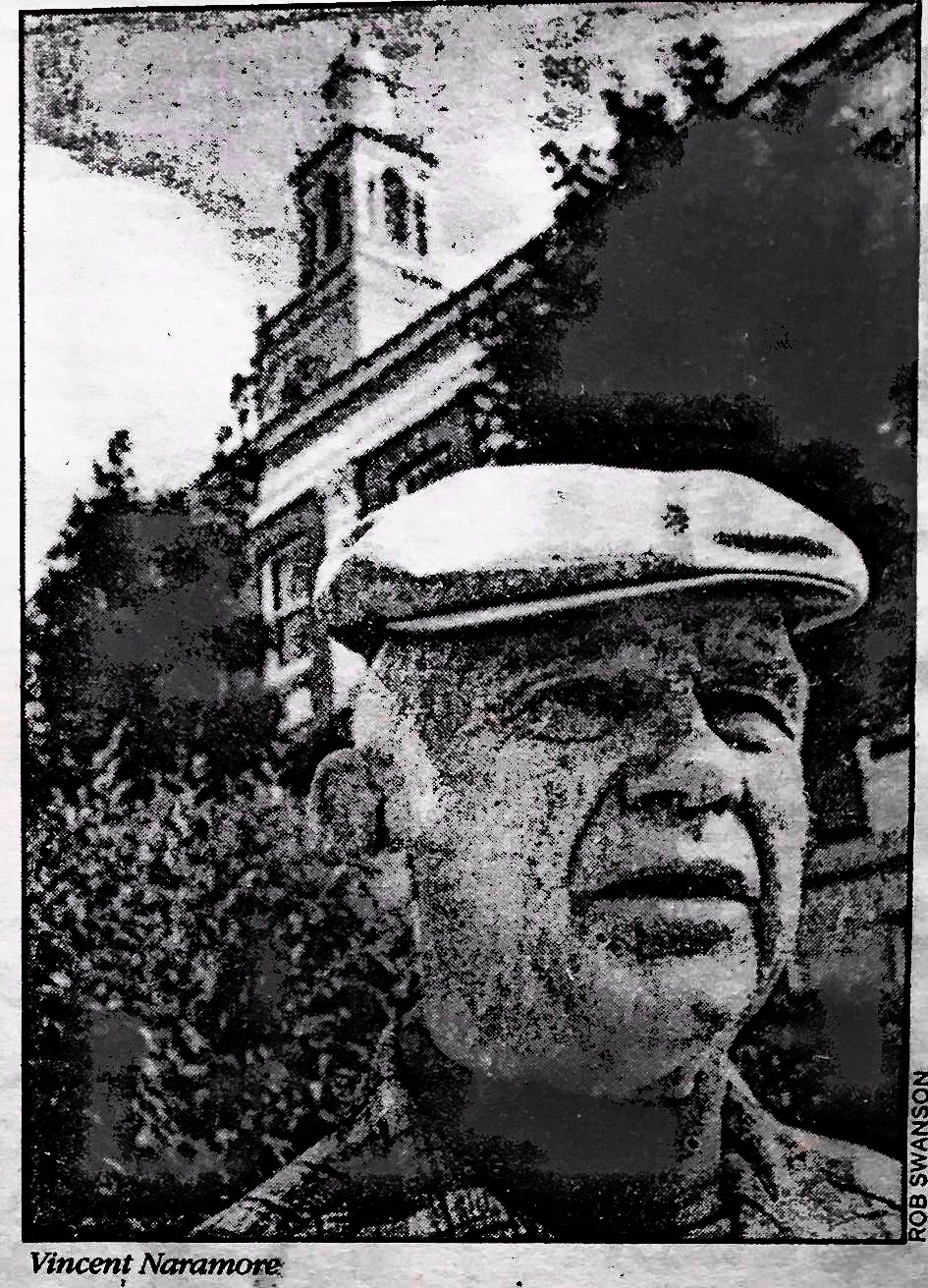
Naramore had good reasons to avoid exposure. A math professor at St. Michael’s College as well as a well-known pollster, he was also a past chairman of the City Democratic Committee. Beyond that, he frequently attended morning coffee gatherings at Nectar’s restaurant with local Party insiders, including the ex-mayor, and the current City Clerk and Treasurer. Another frequent Nectar’s attendee was Brian Burns, former lieutenant governor, brother of a current Council member, and possible Sanders challenger in the next election for mayor.
And there was more. Naramore’s sister-in-law worked in the City Clerk’s office. Naramore himself had accompanied Mayor Paquette on an election day tour of city polling places. But he was neither a pollster nor an adviser to Paquette at the time, he claimed, “just a close friend.”
After Naramore’s exposure as editor, the Flea Press immediately vanished, never to return. But the poisonous atmosphere it had helped to create lingered on, in City Hall and beyond. Through most of 1981, Sanders had to endure working with hostile staff, including two of Naramore’s close friends (and probable co-conspirators), City Treasurer Austin and City Clerk Wagner.
But the past was catching up with the last administration. In October, we published an investigative cover feature in the Vanguard Press called “Highway Robbery?” The subtitle proclaimed, “State Law Dodged to Fund Southern Connector.” As the lead explained, the Vermont Highway Department had been spending money on Burlington’s controversial connector road for three years. But State Highway officials knew that the city hadn’t allocated local funds in time to meet a legal deadline.
Documents obtained by the newspaper showed that Burlington officials, including former Mayor Paquette and Wagner, were aware of the deadline. So aware, in fact, that Wagner wrote a letter to a highway planning official falsely claiming that “voters of the City of Burlington approved the local portion of the cost for the project at the Annual City Meeting held March 1, 1977.”
No such vote had taken place. The public wasn’t asked for bond authorization until 1979, six months after the deadline. But the State Highway Department accepted the false statement and never asked for further proof. After the Vanguard story appeared, however, Wagner went on vacation and never returned to work.
A few months later, a hundred progressive volunteers canvassed the city and staged an impressive get-out-the-vote effort. When the votes were tallied that March, Sanders had five supporters on the City Council, up from two, and there was no denying that Burlington had a multiparty political system. Rik Musty and Zoe Breiner joined Terry Bouricius in the Citizens Party group; Gary DeCarolis, who had lost to Sanders supporter Sadie White in 1981, now joined her as an Independent.
It took four more years for this loose organization to become the Progressive Coalition. But it had demonstrated that Sanders’ election was neither a fluke nor a socialist revolution, but instead the beginning of a political realignment.

In 1983, only days before the next mayoral vote, Sanders’ Republican opponent played the Socialist card one more time. WARNING! shouted the headline of a full-page ad in the Free Press. If Bernie won a second term, it charged, the consequences would be dire.
“Mayor Sanders is an avowed Socialist,” the GOP ad accused. “Socialist principles have not worked anywhere in the world...They won’t work in Burlington either.”
It was a desperate move that suggested Sanders’ leadership would produce everything from higher electric bills to more unemployment. And it turned out to be a major tactical mistake. Burlington voters had seen him and other progressives in action for two years, and rejected the hysteria and negativity. On March 1, Bernie Sanders won a clear majority of 52 percent in a three-way race. Progressive politics was in Burlington to stay.
Reflecting on his first victory in 1981, Sanders concluded, “I think we had pretty much of a class vote.” Almost 40 years later, it remains to be seen whether national Democratic leaders are more open and inclusive than local Democrats were after Sanders’ first win. If they are, the rest of the country could get to cast a class vote of its own.

For More: Poisoned Press Portfolio


