Showing posts with label drugs. Show all posts

Thursday, January 2, 2020

UNWITTING: Finding Truth in an Invisible War

When Vermonter William Pierce’s troubles began he had no solid evidence that mind control projects were being pursued by the government. But once MKULTRA documents were declassified in 1977 his personal experiences —from the McCarthy era to the Cuban missile crisis — began to look uncannily close to the CIA’s experiments. And when he was involuntarily committed in 1962, he found himself in the care of Louis “Jolly” West. One of the leading MKULTRA doctors, West had just killed an elephant with LSD. 


Chapter Eight: End Games
(The Secret War on William Pierce)

After hours of interviews and a careful review of Pierce’s writing and documents, I concluded that he was certainly paranoid and in need of psychiatric help. And yet, his underlying complaint — that he had been the unwitting victim of a psychological attack — was supported by strong circumstantial evidence and a series of inexplicable coincidences. Something or someone did get him. 
Beginning in the mid-1950s, government agencies had indeed conducted top secret research on how to manipulate behavior, including the use of disorienting drugs and micro-transmitters. And Pierce had been harassed at various times for his liberal leanings and outbursts. But it was impossible to determine whether he was purposely drugged or harassed with a tiny transmitter. During the Cuban Missile crisis, however, he was involuntarily committed with a flimsy excuse, held for months under the supervision of an MKULTRA pioneer, and released despite an unchanged diagnosis, possibly because he was annoyingly rational and continued to make trouble. The entire experience had shattered him, and possibly induced psychosis.
Sure, he came across as unstable and defensive, and sometimes thought unnamed forces were still harassing him. But his story didn’t vary, the dates and most of the people checked out, and he had kept receipts in the form of documents and detailed accounts. Plus, his analysis of the threat, the thing that had driven him from the start, was on the mark. And chilling. One report, dated August 9, 1964, written while he was living at home in Lyndonville after his Oklahoma ordeal, was presciently titled “New Threats to Privacy and Civil Liberties.” It began:
“Modern science poses unusual new threats to the traditional privacy and freedom of Americans. Bugging and other snooping devices have come into widespread misuse… Psychological conditioning and organized scientific sociology have been used for political purposes in the academic establishment. In particular, ambitious opportunists have exploited the public concern about Communism to organize attacks on alleged Reds, subversives, and other “undesirables.” One of the most alarming developments had been the underground alliance between right-wing extremists and security personnel.”
He even had a basic action program: expose the facts, protect the rights of individuals, and develop legal safeguards to keep “Brave New Science” honest and safe. Armed with his sources, my research, and the available facts, it no longer sounded so delusional to me.

   
Hoping to discover more in government files, in early 1980 I composed letters for Pierce to eight federal agencies, requesting documents under the Freedom of Information Act. These notarized requests asked for anything related to his time on the faculty at four universities, as well as his work for the NSA in 1953. Not surprisingly, all the agencies claimed to have nothing in their files. But a brief reply from NSA was unintentionally revealing. Even though Pierce had worked there, Information Policy Chief Charles Sullivan claimed that they were “unable to locate any files listed under your name in this Agency’s systems or records or files.” It was less than convincing.
In 2013, when I conducted a follow up online search, one piece of correspondence between Pierce and the CIA did turn up. Dated August 1, 1960 and addressed to him at the Syracuse Math Department, it included this statement: “Mr. Dulles (CIA Director at the time) asked me to acknowledge and thank you for your letter of 9 July 1960 enclosing a message to Dr. Glennan of NASA and Mr. D.H. Lewis. The thoughtfulness in bringing our attention to your proposal is indeed appreciated.”
What was his proposal? Electronic mental telepathy, Pierce called it. “Though the technical requirements have already been met, the process and application are new,” he explained. It was really a fishing expedition, an attempt to discover whether his suspicions were true. In the referenced letter to NASA, he pointed to the work being done at the Aviation Medicine School in Texas, where tiny transmitters were being used for research, as well as cybernetic work underway to assist with space exploration, and “extensive use of various voice analyzers and signal separators.” 
Every agency we contacted in 1980, including NASA, NSA and CIA, denied ever hearing from Pierce or knowing anything about him. Nevertheless, he had clearly gotten their attention.
While studying the first amendment that summer in southern California under a National Endowment for the Humanities fellowship, I was able to verify most of Louis West’s career highlights. After his early assignments at Lackland AFB and posts in Oklahoma during the 1960s, he had moved to Los Angeles in 1969 and established himself as a leading figure in neuropsychiatry. He was also connected with the Brain Research Institute, Israeli Center for Psychobiology, National Academy of Religion and Mental Health, California Alcoholism Council, Pavlovian Society, and White House Conference on Civil Rights.  
But before I could share the new information and insights, along with some FOIA documents I obtained on Subproject 43, word arrived that Pierce was dead. At 59 years old, he passed away around October 12, 1980. His body wasn’t discovered until almost a week later. According to the medical examiner, the specific cause of death wasn’t clear. But he confirmed that Pierce had suffered from advanced cirrhosis of the liver and inflammation of the pancreas, both related to alcoholism, and coronary arteriosclerosis.
A few weeks earlier, Pierce had shared a final truth about himself, one that may help explain why he was targeted in the first place. He was gay and in the closet. His 1962 medical records revealed only hints about “predisposing factors.” The most obvious clue was this brief description: “Obese child who lived with widowed mother and who has functioned in a passive dependent manner.” During the 1950s discovery of such a secret, combined with his incessant letter-writing, could have placed an invisible target on his back.
His doctor lived another 18 years. But in late 1998, Jolly
Louis “Jolly” West, MKULTRA’s
LSD mind games doctor, was
in control until the end.   
West learned that he was dying of cancer and told his son. At 75 years old, hip pain had led to an X-ray. “It took me about ten seconds to register what I saw. There were metastases throughout my skeleteon. Cancer everywhere. I realized I was looking at a death sentence.”
As usual, he wanted to stay in control. And he had a plan. “If I knock off a little ahead of schedule, nobody’s going to know the difference,” he told his son, “and I’ll have saved myself a hell of a lot of pain.” Then he added, “But I’ll need you on board, to help me.” John West agreed.
On January 2, 1999, the two men followed through. After the younger West picked up a prescription for enough Seconal to do the job, the elder West combined them with assorted pills he had on hand — a bathroom pharmacy that included methadone, heptabarbital, Ambien, and morphine. From falling asleep to respiratory/cardiac arrest, it took only twenty minutes to die. “Mr. Totally in Control,” as his loving son sometimes called him, had done it again.
Less than six months later, on the same day Jolly West’s portrait was hung in the foyer of the Louis Joylon West Auditorium at UCLA’s Neuropsychiatric Institute, John West’s mother Kathryn asked him to do her the same favor, assist with her suicide. Again he complied. 
As West explained in his bittersweet book about their final days, “I believe, as they did, in freedom of choice, the right to personal privacy and self-determination.” Unfortunately, the same rights were denied to William Pierce.


Previous chapters
OneWrong Turn
Four: Chung's Way
Seven: Bad Medicine

This and previous chapters will appear in the forthcoming book, Informed Dissent

Saturday, December 21, 2019

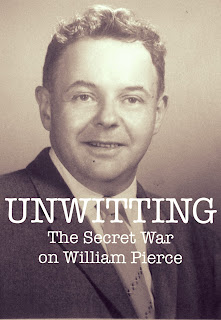
UNWITTING: The Secret War on William Pierce

When Vermonter William Pierce’s troubles began he had no solid evidence that mind control projects were being pursued by the government. But once MKULTRA documents were declassified in 1977 his personal experiences —from the McCarthy era to the Cuban missile crisis — began to look uncannily close to the CIA’s experiments. And when he was involuntarily committed in 1962, he found himself in the care of one of the leading MKULTRA doctors

By Greg Guma

Chapter One: Wrong Turn

He had nightmares when he was wide awake. Nervous and garrulous, he couldn’t resist running over the accomplishments in his past – prestigious places he had taught, famous scientists and intellectuals he had known, mathematical breakthroughs that had brought him early acclaim. 
     The words came fast and urgently as William Pierce struggled to sound confident about what he was saying. But at times he let out a small laugh that betrayed his underlying fears, mostly that he might come across as crazy.
     He was 57 when we first met. Once a gifted mathematician, a university professor with a Harvard Ph.D., and valedictorian of the 1943 University of Vermont graduating class, Pierce no longer looked very collegiate or professorial. Five foot three, out of shape and overweight, he shambled into the editorial office in a frayed, rumbled suit and had clearly been drinking.
     He had tracked me down at the Vermont Vanguard Press, the weekly paper I edited, after attending a talk about intelligence community abuses. The talk was mostly based on my investigation of FBI disinformation surrounding the arrest of a so-called “terrorist suspect” at the Canadian border. Pierce claimed he had an even more explosive story to tell.
     It wasn't difficult to verify his academic credentials and past employment. William A. Pierce had indeed been an academic star. Born in Lyndonville in 1921, he received the highest academic grades as a UVM undergraduate since John Dewey. After graduating in 1943 with an award for “unusual excellence in scholarship,” he was swept into World War II and served in the Navy at a Virginia proving ground until 1946. “I doubled as mathematician and church organist,” he recalled. After the war came three years at Harvard, where he taught and completed his doctorate.
     In 1950, attracted by “an excellent group of research scholars,” Pierce joined the Math Department at Syracuse University. But the City of Syracuse “was then a hotbed of anti-Communist activity,” he told me, “and the University was under considerable pressure to do something about ‘them reds on the faculty’ – especially the Jewish reds in the Math Department.”
     Syracuse was also the home of Laurence Johnson, supermarket chain owner and ardent enforcer of the McCarthy era blacklist. Johnson was widely known for threatening to place signs in his stores that warned customers not to buy the products of any company that sponsored a TV or radio program featuring one of "Stalin's little creatures." This meant anyone in Red Channels, a 213-page compilation of entertainers with alleged Communist links. 
     Some of the country’s largest corporations had bowed to Johnson’s pressure.
     A few months after Pierce arrival on campus, Dr. Donald Kibbey, acting Math Department chair, fired two members of the faculty for alleged activities in “controversial” political groups. Several other mathematicians submitted their resignations in solidarity, and one colleague, Professor Paul Rosenbloom, warned Pierce that he “was terribly wrong to stay at Syracuse.”
     Years later, Pierce chided himself for not seeking a teaching post elsewhere, as some of his colleagues did. “I was certainly untrue to myself,” he said. “It was the worst mistake I have ever made."  
     One reason was that the new math Chair wanted to reorient and rebuild his department “along security lines.” An early warning of the trouble ahead emerged during an argument between them. Pierce recalled Kibbey’s face literally turning red as he labeled Franklin Roosevelt a “crook” and accused Rosenbloom of being a Communist.  
     “At Harvard and Syracuse I was considered a left-winger,” Pierce admitted. “The label resulted partly from my membership in peace groups and opposition to the Cold War, but it was primarily my criticism of FBI investigations and security procedure in areas of human learning. There was some trouble, for instance, when I described Russian advances in certain fields of mathematics and science, and then urged that Americans wage a more effective, peaceable competition with the Soviet Union.”
     “Listen buddy,” one colleague snapped in response, “”if you don’t like your Uncle Sammy, get the hell back to Russia.”

Next: Naming Names

Tuesday, September 5, 2017

Hollywood Whitewashes History into Action Adventure

The latest Tom Cruise movie, American Made, manages the incredible -- to sympathize with an amoral drug smuggler and government informer whose lies sparked a deadly, early example of fake news. The target of the disinformation was Nicaragua, the authors were the President and his men, and the Big Lie was that Sandinista leaders had struck a deal with the Medellin cartel to smuggle drugs into America. 

While director Doug Limon's thrill ride version of Barry Seal's story does acknowledge his questionable role in the Contra war, the film is really about an exuberant flyboy -- Maverick is back as an anti-hero -- who stumbles into high adventures and government conspiracies. The twist (spoiler) is that this time Cruise dies. 

Think Air America meets Mission Impossible and The Parallax View. We've seen this movie before, only this time it's a whitewash of some relevant history.

Bay of Pigs veterans Rene Corvo and Felipe Vidal were "lieutenants"
 for John Hull and provided a link between Contras and Cuban exiles.
From Iran-Contra Scandal Trading Cards by Salim Yaqub.
Let's begin with a televised speech by President Ronald Reagan on March 16, 1986. During this appearance Reagan displayed a photograph taken in Nicaragua, reportedly proving that top Nicaraguan officials were involved in cocaine trafficking. As it turned out, this was a lie. There was no real evidence, and the Drug Enforcement Agency (DEA) was later forced to issue a low-key "clarification." 

Still, the smear proved effective as a narrative changer. Like a series of Trump tweets, it distracted attention from an ongoing investigation of Contra involvement in the drug trade. And Barry Seal, apparently the only person who knew the truth about the grainy picture of men loading a plane near Managua, was already dead.

A DEA informant and pilot, Seal was murdered in Baton Rouge on February 19, 1986 -- a month before Reagan's fake news address -- reportedly on orders from the Columbian cocaine boss who had arranged the shipments in association with the Contra network. Although the assassins were captured and convicted, some believe that the CIA was also complicit in Seal's death. 

His activities, and their Contra-cocaine connections, were the subject of several in-depth investigations at the time. But Cruise sought the role because of his interest in Seal as a character. “I don’t agree with what he was doing, but you can’t help but be utterly fascinated by it,” he told People Magazine. “One of my favorite authors is Mark Twain, and Seal reminds me of one of his characters. It’s not every day you get to play a character who is a devoted husband and father and a drug runner, a CIA operative working for the DEA.”

That's one way to see it. Another appeared in a report by the International Center for Development Policy, which was directed by former UN Ambassador to El Salvador Robert White. For them, Seal was a dangerous pawn who knew too much. For example, he knew that Columbia's Medellin cartel was using a ranch owned by John Hull as a shipping point. Hull was a US citizen with CIA and National Security Council connections, and his ranch was also a Contra base for weapons shipments and recruits.
John Hull owned the ranch used by Contras and drug smugglers. 
More to the point, Seal knew that the famous photo shown on TV by Reagan was actually taken on US government orders. He had flown into a Nicaraguan airstrip with CIA cameras installed on his plane, snapping pictures that purportedly showed Pablo Escobar and other members of the Medellin cartel loading kilos of cocaine onto a plane. Seal claimed they were being assisted Sandinista soldiers. He even alleged that one of those present was a close associate of Tomas Borge, Nicaragua's Minister of the Interior. In short, he was circulating disinformation. 

Wall Street Journal reporter Jonathan Kwitny effectively debunked the accusations, establishing that there was no evidence tying any Nicaraguan officials to the drug shipment. But someone in the White House wasn't satisfied, and leaked a story about Sandinista links with the Medellin cartel, along with the photo, to The Washington Times.  Among other revelations, Edmond Jacoby's report discussed Seal’s role and appeared to out him as a government agent. As a result, noted Ambassador White, the Columbian cartel put a $2 million price on his head.

After Seal's death, Louisiana attorney general William Guste protested the government’s failure to protect their "extremely valuable witness and informant in the country’s fight against illegal drugs.” For him, Seal's murder warranted a serious inquiry, one that explained why "an important witness was not given protection whether he wanted it or not?”

American Made, which is slated for US release in late September, doesn't settle this question. But there is an obvious answer: Seal was a loose end and his shipments were just a small part of a much larger, ongoing operation to transport cocaine in exchange for funds to purchase arms. Hull and anti-Castro Cubans had begun to work together in 1983, providing refueling and packaging services on his Costa Rican ranch in exchange for up to $25,000 per shipment from the Columbians.

According to Dan Sheehan, whose interfaith law and policy center dug deeply into the private network that fueled the Contras, the same team continued to smuggle a ton of cocaine into the US each week for several more years. Its street value was $25 million per shipment. Sheehan also claimed that some of the profits were deposited in Miami and Central American banks, then later withdrawn to purchase weapons.

Similar charges were leveled in a civil complaint filed by journalists Tony Avirgan and Martha Honey. They charged that the network was responsible for a bombing in Costa Rica in which Contra leader Eden Pastora and several others were injured or killed. 

Honey and Avirgan discovered that a deal was struck between Hull, the Cuban-Americans and Contra leaders to get rid of Pastora, who had refused to merge his operations with other anti-Sandinista forces. From their Costa Rica base on Hull's ranch drugs flowed to several distribution points in the US. The profits paid for weapons from Florida, Israel and South Korea, according to the White report. When Pastora declined to cooperate, the network hired a professional assassin to eliminate him. Avirgan was one of those injured in the attack.

Now that would make a great political action thriller, one in which the heroes are independent journalists on the trail of an international conspiracy rather than a smuggler/snitch who facilitated it and got himself killed. 

On January 20, 1987, the New York Times revealed that the DEA had known for months that US flight crews transporting arms to the Contras were also smuggling cocaine on their return trips to the US. When told about the investigation, however, one crew member reportedly warned a reporter that he was under the protection of a White House official, Lt. Col. Oliver North.

Predictably, the State Department denied all knowledge of Contra involvement in cocaine deals. And the US Customs Service claimed to know nothing about any arms shipments leaving Florida without official clearance. Nevertheless, both the weapons and drugs reached their destinations, and the same network -- in which Barry Seal was one cog -- conducted both operations.
Oliver North defended the "enterprise" in Congressional Testimony. 
Over time, various elements of this covert network, which became known as the Secret Team, were exposed. For example, we learned -- and subsequently overlooked -- that as Vice President George H.W. Bush and his national security advisers had close ties with the covert air supply operation. Elliott Abrams, then in the State Department and still a foreign policy player, was directly involved in coordinating Contra activities, bringing together State, the NSC and CIA. The Department of Defense organized air drops over Nicaragua and helped to build the Contra infrastructure. The entire inter-agency program was initially under the control of CIA Director William Casey.

The private network that emerged from all these connections used the money obtained from Iran arms sales and other sources to buy weapons and ship them to Central America, South Africa, and Angola. They also worked with operations in both El Salvador and Costa Rica, moving drugs and guns back and forth. But this bigger picture doesn't feature in Limon's Catch Me If You Can take on covert war in Central America. 

After elements of the Contra-cocaine conspiracy were exposed, Seal was not the only key witness to die under mysterious circumstances. Still others were threatened, while groups attempting to bring those responsible to justice were burglarized and harassed. It sounded like high-pitched rhetoric at the time, but Christic Institute lawyer Dan Sheehan charged that ultra-right elements were responsible for a pattern of intimidation. In its Central American embassies, he claimed, the US had embedded "a series of fascist and Hitlerite cells." It's not as hard to believe thirty years later.

Of course, not everything can be tracked back to the White House, or even to the Intelligence community. But covert operations like those chronicled in American Made did become almost standard operation procedure during the 1980s. And although they were sometimes clearly illegal, they were also widely rationalized as acceptable "initiatives" in defense of democracy. 

One powerful excuse, made by President Reagan himself, was that any laws restricting military intervention did not apply to him or his national security staff. It was a bold assertion of unilateral executive power. He and his aides even claimed that, by extension, any attempts to "protect the initiative" -- and that included covering it up -- are part of the authority flowing from the sovereign president. We may soon hear the same argument again, as more damaging details emerge about Russia, Trump and today's Secret Team.

Greg Guma is the Vermont-based author of “Dons of Time,” “Uneasy Empire,” “Spirits of Desire,” "Big Lies," and “The People’s Republic: Vermont and the Sanders Revolution.” His latest book is “Green Mountain Politics: Restless Spirits, Popular Movements.” 

Friday, June 2, 2017

UNWITTING: Testing the Limits with MKULTRA

Chapter Five: Mastering Minds 
(The Secret War on William Pierce)

When Bill Pierce’s real troubles began he had no solid evidence that mind control projects were being actively pursued by the federal government. For years he sounded like a crank, paranoid and possibly delusional. But once the surviving MKULTRA documents were declassified in 1977 – most of them were destroyed before they could be reviewed by Congress -- his descriptions and personal experiences in the 1950s and 60s began to look uncannily close to the experiments actually being pursued by the CIA at the time.
       Even prior to MKULTRA,  considerable research had been done by the government on amnesia, hypnotic couriers and efforts to create a Manchurian Candidate – a label commonly used after the release of a 1963 conspiracy thriller with that title. The CIA’s goal was to develop “brainwashing” techniques and program subjects with a hypnotically implanted trigger, thus turning them into secret agents who wouldn’t remember what they had done. In scientific terms, the objective was to deliberately and experimentally create dissociative identity disorders, with associated amnesia barriers, and use this technique in both simulated and actual covert operations.
      MKULTRA was officially launched by the Central Intelligence Agency on April 3, 1953, and continued for a decade until it was rolled into another project, MKSEARCH, in 1964. That ran for another eight years, until CIA Director Richard Helms ordered most of the MK documents shredded in June 1972. Despite this, and redactions to most documents that did survive, they revealed that there had been hundreds of separate sub-projects.
        The Agency’s goal was explained directly in a memo revealed in the 1975 Rockefeller Commission investigation of the project: “Can we get control of an individual to the point where he will do our bidding against his will and even against fundamental laws of nature, such as self-preservation?” To that end, dozens of civilians and government employees were drugged without their knowedge, and at least one person died. In 1953, biological weapons specialist Frank Olson was given LSD without his knowledge. A few days later, he either jumped to his death or was pushed from a hotel window.
The most discussed aspect of MKULTRA is the CIA’s LSD work. But the program included many unusual investigations into mind control. CIA researchers also probed the potential of various parapsychological phenomena, including hypnosis, telepathy, precognition, and "remote viewing." The agency, led by Allen Dulles, was looking for weapons that would give the US the upper hand in the emerging “mind wars,” and invested millions in studies looking into dozens of ways to manipulate people. 
     A key MKULTRA document, prepared by Dr. Sidney Gottlieb in May 1955, indicates a wide range of interests, and the use of all manner of mind-altering substances. At the top of the list were any drugs or approaches that would “promote illogical thinking and impulsiveness to the point where the recipient would be discredited in public.” It read like an accurate description of what was happening to Pierce.
     In an August 1963 “Report of Inspection of MKULTRA,” Deputy CIA Director Marshall Carter acknowledged a problem: “Research in the manipulation of human behavior is considered by many authorities in medicine and related fields to be professionally unethical, therefore the reputations of professional participants in the MKULTRA program are on occasion in jeopardy.” Beyond that, “the testing of MKULTRA products places the rights and interests of U.S. citizens in jeopardy.” As a result, the paper trail was being kept to a bare minimum, operational control was delegated to the Technical Services Division (TSD), and the entire project was exempted from audit.
      During the preceding ten years the “avenues to the control of human behavior” had expanded to include “radiation, electro-shock, various fields of psychology, psychiatry, sociology, and anthropology, graphology, harassment substances, and paramilitary devices and materials.” Under a heading titled “Advanced testing of MKULTRA materials,” the 1963 CIA report asserted the “firm doctrine in TSD that testing of materials under accepted scientific procedure fails to disclose the full pattern of reactions and attributions that may occur in operational situations.” It added that TSD “initiated a program for covert testing of materials on unwitting U.S, citizens in 1955,” the same year Pierce said his own troubles began.
      The ultimate test for any drug, device or technique, argued the report, was “application to unwitting subjects in normal life settings. It was noted earlier that the capabilities of MKULTRA substances to produce disabling or discrediting effects or to increase the effectiveness of interrogation of hostile subjects cannot be established solely through testing on volunteer populations.”
      To keep the loop small and secure, “certain cleared and witting individuals in the Bureau of Narcotics” provided various drugs for testing on those “deemed desirable and feasible.” Some of the most “feasible” subjects were informers and criminals. But as the report added, “the effectiveness of the substances on individuals at all social levels, high and low, native American and foreign, is of great significance and testing has been performed on a variety of individuals within these categories.” In some cases, “the test subject has become ill for hours or days, including hospitalization in at least one case.”
      Bill Pierce was no longer teaching at Syracuse in 1962. After a year at West Virginia University, he had moved to Stillwater to teach at Oklahoma State University that September. But he was still writing letters to prominent individuals and newspapers about “right-wing extremism” and “security procedures." 
       Then suddenly, in mid-October, he was removed from his teaching duties and ordered by the university administration to undergo a psychological examination. According to Pierce, "extremists" were trying to discredit him. But some students, along with the manager of a local coffee shop, told President Oliver Willham that Pierce was the one creating disturbances. Word rapidly spread across campus that he was “psycho.” It was precisely what he feared and had been writing about. 
   On October 14, 1962, American spy planes shooting photos over Cuba had captured images of mobile Soviet-made missile launchers. Six days later, on October 20, President Kennedy called for a quarantine of Cuba, meaning that the U.S. Navy would stop ships from reaching the island’s port. It wasn’t called a blockade; that would have been an act of war. But it was obviously a national crisis.
      Being at the brink of a nuclear showdown didn’t dissuade Pierce from publicly airing his concerns about government repression of its critics. In a letter published in the Oklahoma City Times one day before the quarantine, his primary focus was the arrest and hospitalization of Maj. Gen. Edwin A. Walker, whose fiery rhetoric had helped to spark a violent riot on the University of Mississippi campus. On September 30, after hundreds of people were wounded and two were killed, Walker was arrested on charges including sedition and insurrection.
      Attorney General Robert Kennedy ordered Walker held in a mental institution for 90 days of psychiatric examination. But the decision was challenged by the American Civil Liberties Union and psychiatrist Thomas Szasz, who argued that psychiatry should not be a political tool. After five days Kennedy backed down and Walker was released.
      Pierce certainly didn’t agree with Walker’s politics. But he did identify with the situation. “Admittedly, Walker’s extreme views on ‘liberals’ and his alleged defiance of the government (including alleged incitement to violence) suggest mental unbalance," he wrote,  but the presumptions of enforced mental tests and/or treatment should cause us grave concern."
      “It is only a short step from psychiatric tests for rioters to psychiatric tests for victims of crime and political persecution,” Pierce warned. “A favorite technique of the latter is clever misuse of the ‘psychopath’ label; and, even worse, revolutionary devices of psychological warfare and brainwashing capable of crippling almost any human being, and in such a manner that the victim’s factual description of the attack sounds like mental illness.”
     A few days after his letter was published a police officer and sheriff’s deputy showed up at his apartment with a warrant for his arrest, apparently at the instigation of President Willham. Sheriff Charlie Fowler had never met Pierce before, yet the detention order  claimed that Fowler had “personal knowledge” that he was violent and showed the potential to injure himself or others.
     A week later, Pierce was involuntarily committed. More ominously --  and without him realizing its significance -- he had been placed in the care of Dr. Louis J. West, one of the CIA’s leading MKULTRA doctors, a cutting-edge scientist who had once killed an elephant with an overdose of LSD.

Chapter One: Wrong Turn

Thursday, May 4, 2017

UNWITTING: Setting the stage for harassment

Chapter Four: Chung's Way
(The Secret War on William Pierce)

In June 1955, about a month after an unsettling talk about Communism and government surveillance with Lilian Hartwell, a new boarder at his home in Syracuse, Bill Pierce attended a Saturday evening cocktail party in town. Students and faculty members were there, including Math Department Chairman Kibbey and Kai Lai Chung, a professor and probability expert who introduced himself to Pierce as the son of a Taiwanese official.
       Kai Lai Chung was no typical member of the Syracuse faculty. Pierce had no way of knowing it, but he was from Hangzhou, a right-wing Kuomintang stronghold until the People's Liberation Army invaded the city and placed it under Communist control on May 3, 1949. 
       At that point the group, known as KMT, retreated to the island of Taiwan. There they used brutal tactics against suspected communists and developed a secret police force to conduct surveillance of political opponents. It continued as the ruling party on Taiwan until reforms instituted from the late 1970s through the 1990s gradually loosened its grip.
       Chung entered Tsinghua University in 1936, a well-connected 19-year-old who initially studied physics. In 1940, he graduated from the Department of Mathematics of National Southwestern Associated University, where he subsequently worked as a teaching assistant. During this period, he studied number theory with Lo-Keng Hua.
       Hua had produced some important work while at Cambridge University, establishing his fame in the international math community. Nevertheless, after the outbreak of the Second Sino-Japanese War in 1938, he chose to return to China, where he was appointed full professor at Tsinghua even though he lacked a degree. With much of China under Japanese occupation Tsinghua, Peking, and Nankai University had merged into the Southwest Associated University in Kunming, capital of the southern province Yunnan. Despite his academic isolation during the war years, Hua produced some first-rate mathematics.
       After Japan bombed Changsha, the remaining staff, faculty and students at Tsinghua fled a thousand miles to China's remote and mountainous southwest and joined with others to create the National Southwest Associated University, known as Lianda. For the next eight years, they worked in makeshift quarters that were often subjected to bombing campaigns by the Imperial Japanese forces. Despite shortages of food, equipment, books, clothing and other essentials they nevertheless ran a modern university, making Lianda University famous nationwide for producing and hosting most of China's prominent academics, scholars, scientists and intellectuals.
      One of the most promising students was Chung, who was ultimately chosen in 1944 for the Boxer Rebellion Indemnity Scholarship Program, a highly competitive, US-funded project that brought Chinese talent to America. Chung arrived at Princeton in December 1945 and obtained his Ph.D. there two years later. His dissertation, “On the maximum partial sum of sequences of independent random variables,” was written under the supervision of John Wilder Tukey and Harald Cramér. 
      Cramér, a Swedish mathematician and actuary who specialized in statistics and probabilistic number theory, was Chung’s Ph.D. advisor. Math chair at Stockholm University at that time, Cramer was also the first Swedish professor of Actuarial Mathematics and Mathematical Statistics. In 1950, he became President of Stockholm University.
      More intriguing was Chung’s other advisor, John W. Tukey, who helped to design the first H-bomb. The program was headed by his friend John Wheeler. In 1945, John von Neumann had enlisted Tukey for a computer development project funded by the Defense Department. Mathematicians were essential to the development of nuclear weapons, especially to test the feasibility of a design through calculations.
      Within a decade Tukey’s promising protégé Chung had taught at some of the leading US schools, moving between University of Chicago, Columbia, UC-Berkeley and Cornell University. In short, Chung had traveled in elite academic circles for years, a loyal anti-Communist who had benefited from those connections. Arriving at Syracuse University, he made contact with another, very different mathematician -- Bill Pierce.
      Shortly after Pierce accepted a drink from Chung at that off-campus party in Syracuse, he began to experience extreme effects. “I felt that I was going to pass out,” he told me. “The next day I was too sick to move, with severe pain in my jaw and head.” The landlady was away, but the overly solicitous Mrs. Lilian Hartwell brought him breakfast and medicine. 
      “I managed to teach my classes, but for the rest of the term my mind was hazy, as though from an anesthetic,” Pierce said. “It would be nearly five years before I discovered what had happened, and almost ten before I could prove it.”
      What exactly was he alleging? And more important, could he prove it? Basically, Pierce claimed that Chung had drugged his drink, knocking him out and setting the stage for “auditory harassment” through a miniature transmitter implanted to replace a filling in one of his teeth.
      It sounded highly unlikely, more likely delusional – that is, until Pierce opened his briefcase and pulled out correspondence with the chief of the Physical Sciences Division of the Department of the Army, a page from Dental Abstracts, and a US Air Force report titled, “Application of Miniaturized Electronic Devices to the Study of Tooth Contact in Complete Dentures.” 
      The response from the Army official said yes, it was possible to hear voices or radio programs through tooth fillings “because of the various materials used in fillings together with accidental ingestion of other particles near the fillings, and the subsequent chance of rectification of signals generated by strong radio waves.” Of course, this wasn’t conclusive. But a notice in Dental Abstracts added another piece to the puzzle with this announcement: 
      “A radio receiver smaller than half a sugar cube has been developed by U.S. Army electronics engineers who say it easily can be further miniaturized. Besides being tiny, a significant feature of this short-wave superheterodyne is its variable tuning.” In other words, the Pierce's claim wasn’t unreasonable: the intelligence community could actually have a tiny, tunable short-wave receiver the size of a tooth. 
     Still, could it be implanted in someone’s mouth? The Air Force report indicated that this had already been done with dentures, mainly to study tooth contact. One photo showed a tiny transmitter with a diameter less than the average tooth. 
      The intelligence community even had a street name for this type of harassment device – shark-bite.

Next: Mastering Minds
Chapter One: Wrong Turn
Two: Naming Names
Three: Unwanted Voices

Friday, February 17, 2017

UNWITTING: "It was a summer of suspicion"

Chapter Two: Naming Names
(The Secret War on William Pierce)

Pierce felt strongly that security clearances were out of place in the academic community and didn’t hesitate to say so publicly. In April 1953, for example, he spoke out about a Presidential Executive Order establishing new security requirements for government employment that included a “loyalty” standard. To him it looked like a form of profiling, another tool of the blacklist.
     Earlier that year William Martin, head of the Syracuse Math department in the 1940s and currently chair at M.I.T., had been called before the House Un-American Activities Committee. Once a member of the Communist Party, he buckled under questioning and named others who, he claimed, had once joined the party. 
     “My Syracuse colleague Professor Abe Gelbart, Dean of Science and Technology at Yeshiva University in New York, was on the list,” Pierce said. “FBI agents moved into Gelbart’s situation and questioned him at length. They even asked him about his associations with me, and said they had observed us drinking in local restaurants.” 
     On May 27, 1953, the night before Gelbart’s HUAC appearance, Pierce visited him at home and noticed suspicious cars driving back and forth in front of the house, as if on patrol. Gelbart claimed that he didn’t blame Martin for naming him. “In fact, he wasn’t sure how he himself would behave,” Pierce recalled. “Men are responsible for their families, he said, and that might mean naming me.”
     The next day, at an executive session of HUAC, Gelbart testified under oath that he wasn’t then a Communist Party member. But he took the Fifth Amendment when asked if he had ever been one. “Abe later told me about a private hearing,” Pierce said, “but he refused to discuss what he might have revealed. He did say that I hadn’t been especially loyal to him, and he was probably right.”

Sen. Joe McCarthy in action, under the eye of Vermont's Ralph Flanders 
     That summer Pierce went to Los Angeles to consult for the National Security Agency at UCLA. “I had a temporary, low-level clearance for work on S.C.A.M.P. and I suppose a security check was initiated.” S.C.A.M.P. was the acronym for the Southern California Applied Mathematics Project, a top secret operation conducted on behalf of the Defense Department. The official purpose was research on numerical analysis, but those involved focused mainly on cryptology. Pierce assumed the objective was cryptanalysis. But he also worked on problems in pure algebra, group theory and number theory.
     It was a summer of suspicion and unsettling Cold War developments. On June 19, Julius and Ethel Rosenberg were electrocuted for the alleged theft of atomic bomb secrets. “Your country is sick with fear,” wrote Jean-Paul Sartre in reply. A month later Fidel Castro led an attack on the Moncada barracks in Cuba, an early attempt to overthrow the Batista dictatorship. At his trial the future Cuban leader proclaimed, “History will absolve me.” 
     One day after the Moncada attack, on July 27, an armistice ended the Korean War. More than 50,000 American had been killed in what had been designated a “police action,” at least 100,000 were wounded, and about 8,000 were missing. Less than a month later, Mohammed Mossadegh, the elected Prime Minister of Iran, was overthrown. Few people knew it at the time, but the coup had been orchestrated by the CIA. 
     While Bill Pierce was in Los Angeles. he noticed headlines about Abe Gelbart’s HUAC appearance. On television Senator Joseph McCarthy complained that Gelbart was receiving a Fulbright Fellowship “even after taking the Fifth Amendment 47 times.” Pierce also saw reports that McCarthy was “setting out for California on another Alger Hiss case.”
     Shortly after returning to Syracuse, Pierce’s government-funded research was abruptly cancelled.